Avoiding Common Mistakes with Perms on Fine Hair
Learn how to safely perm fine hair by avoiding common mistakes that can damage the hair fiber. Discover the ideal curler size, post-perm care, and the importance of spacing treatments.
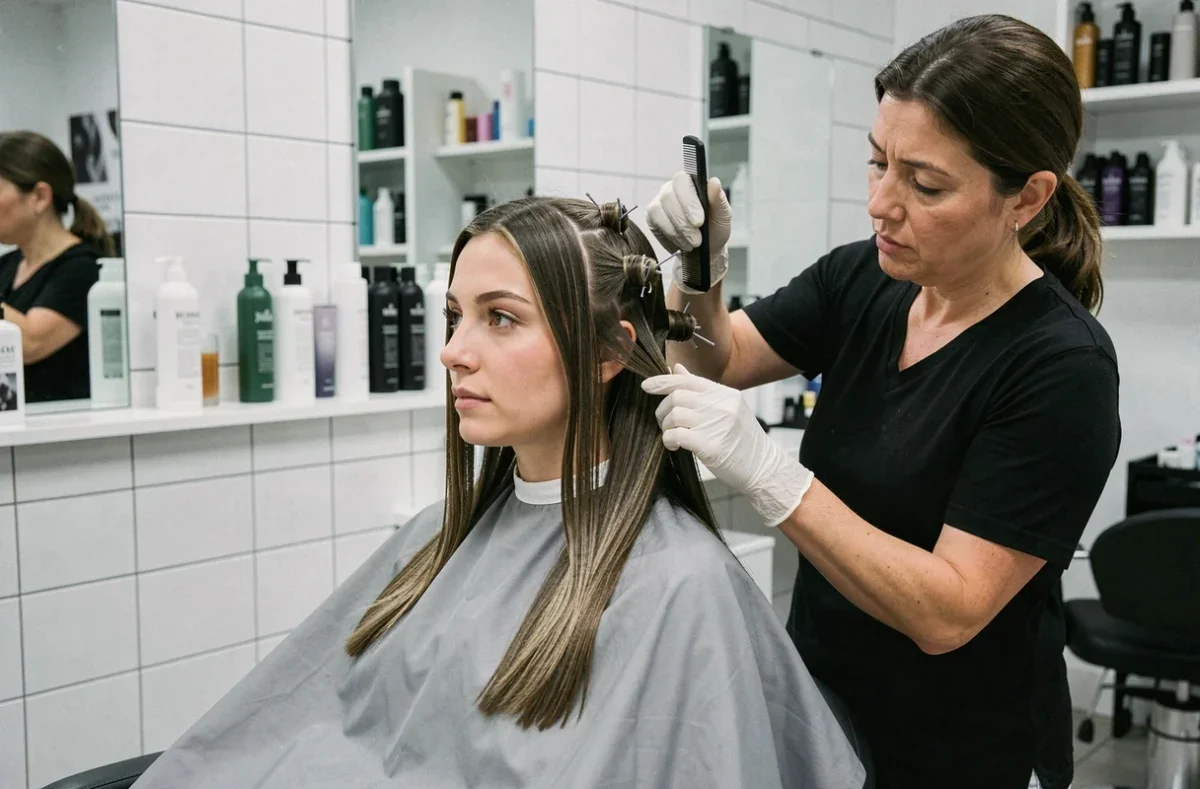
Creating a perm on fine, naturally straight hair requires a precise chemical protocol. Fine hair, with a diameter smaller than that of average hair, reacts more quickly to reducing agents and is less tolerant of dosage or timing errors. This article examines the impact of various mistakes on the curl's longevity and the integrity of the hair fiber.
Common Mistakes and Their Consequences
Not all mistakes carry the same weight. Some can compromise the curl's hold, while others may cause lasting damage to the hair fiber. The following table categorizes the most significant errors based on their risk level for fine, straight hair.
| Error | Consequence on Curl | Consequence on Fiber | Reversibility | |-------|---------------------|---------------------|---------------| | Choosing overly small curlers (tight curl) | Flattened volume, "sheep" effect | Excessive tension, breakage | Low (cutting necessary) | | Combining perm with aggressive coloring | Irregular curl | Double chemical aggression, porosity | Low | | Touching up before three months | Overprocessing of previously permed lengths | Gradual weakening, split ends | Medium (if stopped quickly) | | Applying conditioner to roots | Weighed down roots, flat curl | No breakage, but loss of volume | High (change in routine) | | Using a shampoo that is too rich or contains harsh sulfates | Prematurely relaxed curl | Drying or weighing down depending on the product | High |
The first two errors in the table are the most critical, as they subject the fiber to irreversible mechanical or chemical stress without the option of cutting.
The Pitfalls of Tight Curls on Fine Hair
On thick hair, a small-diameter curler creates a defined and resilient spiral. However, the opposite is true for fine hair. The hair fiber lacks the volume to withstand the tension of a tight curl, leading to breakage within weeks.
Visually, a very tight curl on fine hair can also be problematic. It creates concentrated volume near the scalp without a natural fall, making the hair appear shorter and denser at the top and flatter at the bottom, contrary to the desired effect.
Recommended Curler Diameter
Medium to large curlers are recommended for achieving soft waves that respect the limited weight of fine fibers. Such curls maintain their shape better over time, as they exert less stress on the internal structure of the hair.
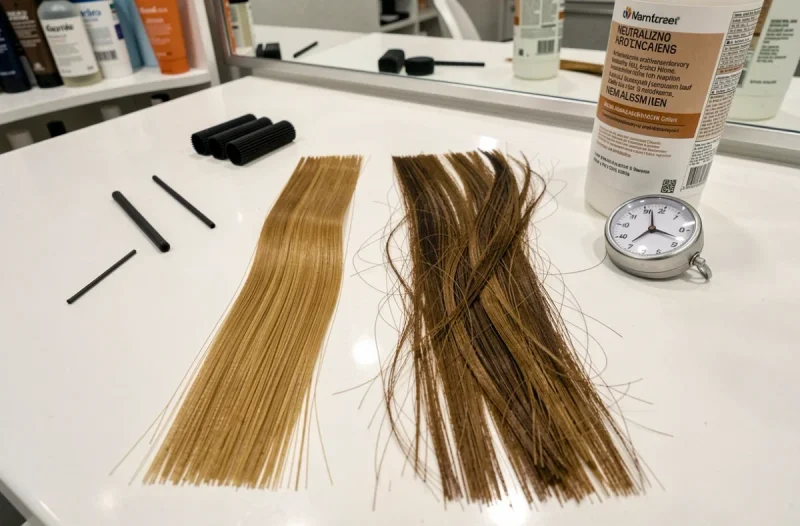
Conducting a test on a hidden strand (for instance, behind the ear) is the most reliable way to assess how the hair will react before treating the entire head.
The Fragility of Combining Perms with Chemical Coloring
Avoid any aggressive coloring in the weeks before or after a perm is a precaution that is often overlooked. Both treatments alter the cortex's structure through distinct chemical reactions (reduction for perms, oxidation for coloring), and their effects on the cuticle compound.
Fine hair has fewer protective layers in the cuticle. The combination of both processes significantly increases porosity, causing the hair to absorb too much moisture in humid conditions and dehydrate too quickly in dry weather, leading to irregular curl deformation.
Plant-Based Coloring: A Compatible Alternative
Plant-based dyes (such as henna or indigo) do not attack the cortex in the same manner. They sit on the surface of the fiber. For fine hair that has already been permed, this is a safer option, provided that there are no metallic salts in the formulation, as these can react with perm products.
Post-Perm Care: Roots Free, Lengths Treated
One of the most common mistakes in post-perm care is applying conditioner from roots to tips. For fine hair, roots should remain free of conditioner to maintain their lightness and volume at the base.
Mid-lengths and tips, however, require targeted hydration. A lightweight conditioner, rinsed immediately (without prolonged exposure), is sufficient to limit tangles without weighing down the curls.
- Use a sulfate-free shampoo formulated for chemically treated hair, massaging the scalp without rubbing the lengths.
- Apply a lightweight conditioner only on mid-lengths and tips, rinsed in under a minute.
- Allow hair to air dry or use a diffuser on low heat; avoid direct blow-drying, which can relax the curl.
- Space out shampoos (no more than two to three per week) to preserve the scalp's natural protective film.
Retouch Frequency: The Three-Month Rule for Fine Hair
Space perms by at least three months to allow the fiber to partially regenerate between treatments. For fine hair, this interval is non-negotiable. The keratin content in fine hair is lower than in thick hair, and each application of reducing agents consumes some of it.
Touching up before this threshold risks overprocessing previously permed areas. The lengths that have undergone the chemical process react more quickly and intensely during a second application, creating a texture disparity between the virgin roots and the overprocessed tips.
Signs of Overprocessing
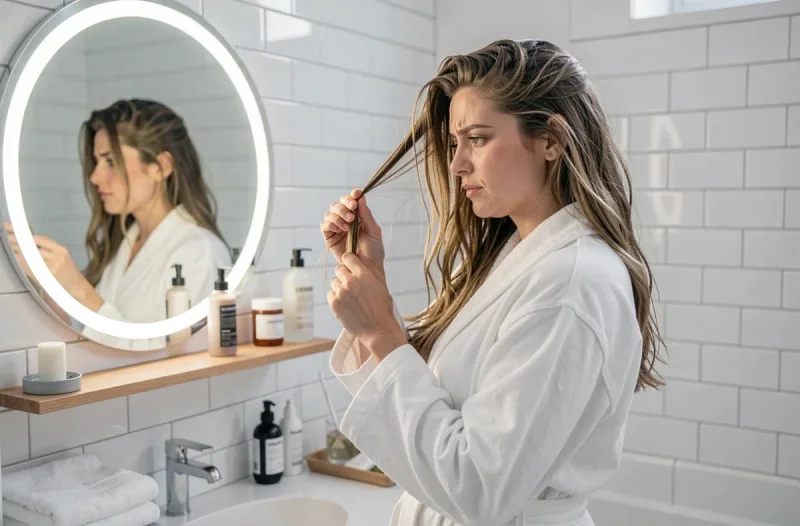
An overprocessed hair strand exhibits an elastic and rubbery texture when wet, stretching abnormally before breaking. If this behavior appears in only a few strands, it is advisable to cut the damaged areas before considering another perm.
The stylist can also perform an elasticity test before each session. This quick check provides a reliable indication of the hair's ability to withstand a new chemical treatment.
Perming fine, straight hair can be successful if the structural fragility of the fiber is respected. The two most damaging mistakes—tight curls and the combination of perming and coloring—are also the easiest to avoid. A strand test before treatment and a minimum three-month interval between sessions remain the two most effective safeguards for preserving curl longevity and hair health.