
Safety of Hyaluronic Acid Injections: Insights for 2026
Explore the safety of hyaluronic acid injections in 2026, focusing on advancements, risks, and best practices in aesthetic medicine.

Safety of Hyaluronic Acid Injections: Insights for 2026
- 15th July 2026
- Thierry PIOLATTO
Dr Jean-Marc Adda From the Evolution of Hyaluronic Acid Gels to the Management of Vascular Risk (Necrosis) in a Context of Growing Demand
Hyaluronic acid injections have emerged as a cornerstone of aesthetic medicine, gaining immense popularity due to advancements in gel technology and a surge in global demand. As the number of practitioners rises, the landscape of aesthetic procedures has become increasingly intricate. Issues such as the rise of unqualified injectors and counterfeit products pose significant challenges. While severe complications are infrequent, risks like vascular accidents can lead to serious consequences, including skin ischaemia and necrosis. This article offers a comprehensive overview of the current state of hyaluronic acid injections, focusing on product advancements, evolving practices, and the anatomy of high-risk areas.
2026 Context: A Mature Practice Facing New Challenges

The aesthetic medicine sector is witnessing remarkable growth, reflected in international surveys that highlight the increasing volume of procedures performed. This surge is accompanied by:
- A rise in the number of injectors across various specializations depending on the region,
- A younger demographic seeking frequent touch-ups and micro-corrections,
- A blending of medical and non-medical practices, particularly in regions with varying regulatory standards.
Evolution of Hyaluronic Acid Gels: Progress and Limitations
The evolution of hyaluronic acid fillers has been characterized by significant enhancements in their physicochemical properties. Improvements in cross-linking, cohesivity, and rheological attributes have enabled these gels to be tailored for specific anatomical layers and aesthetic goals. Consequently, safety now hinges on the precise alignment of the product with the treatment area and injection technique.
Vascular Risk: A Rare but Irreducible Event
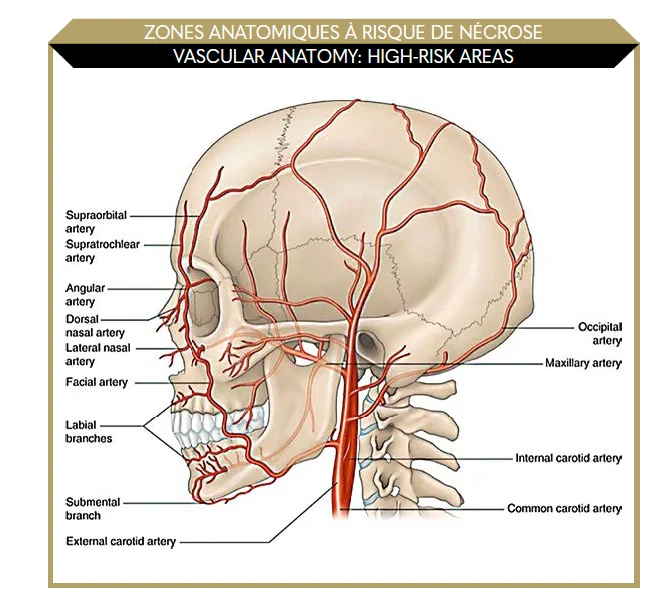
Vascular complications can arise from both intravascular embolization and extravascular pressure. These complications may lead to skin ischaemia, necrosis, or even ophthalmic issues. Certain facial regions, particularly those rich in arterial connections, are notably at risk.
Anatomical Considerations: High-Risk Areas and Vascular Logic
The facial structure presents a complex network of:
- Superficial and deep arterial systems,
- Connections between external and internal carotid arteries, especially through the orbital region,
- Variations in anatomy among individuals,
- Proximity of larger vessels to common injection sites.
Modern guidelines recommend a “territory/angiosome” approach to help anticipate ischaemia patterns and inform management strategies.
Areas Traditionally Considered High Risk (Ischaemia/Necrosis)
The following regions are frequently identified as being at increased risk for occlusion and ischaemia:
- Glabella and Forehead: Involvement of supratrochlear and supraorbital arteries poses risks of local ischaemia and potential ophthalmic complications.
- Nose: The dorsum, tip, and alae are susceptible due to the dorsal nasal artery and branches of the angular artery; nasal skin is particularly sensitive to ischaemia.
- Nasolabial Fold / Angular Region: Close proximity to facial and angular arteries makes this a common site for reported necrosis.
- Tear Trough / Infraorbital Region: Vulnerable due to infraorbital vessels and proximity to the orbit.
- Temple: The superficial temporal artery and its branches are at risk, especially with bolus injections.
- Lips: Labial arteries can lead to occlusion, which is often reversible but may result in necrosis if not treated promptly.
Literature on vascular complications emphasizes the importance of recognizing warning signs and the need for immediate diagnosis to prevent necrosis.
Factors Increasing Anatomical and Clinical Risk
Several factors can heighten the risk of complications:
- Surgical history (e.g., rhinoplasty) altering vascular pathways,
- Skin conditions such as thinning or scarring,
- Deep injections in anatomically variable areas,
- Large volume injections and high pressure.
Guidelines for managing occlusions stress the need for caution in previously operated areas.
Facial Vascular Anatomy: High-Risk Areas
Techniques and Prevention: Between Progress and a False Sense of Security
Although the introduction of microcannulas has decreased the incidence of occlusions, they have not completely eliminated the risk. Aspiration testing, once a standard practice, is now considered unreliable. High-frequency ultrasound technology offers promising avenues for vascular visualization and complication management, although its adoption is limited by factors such as training needs, costs, and time constraints. Observational studies indicate that practitioners are increasingly concerned about intravascular risks and are seeking solutions that provide real-time feedback.
Conclusion and Perspectives: Towards the Need for a New Paradigm of Instrumental Safety
As we look towards 2026, the safety of hyaluronic acid injections must evolve beyond mere operator expertise and adherence to technical standards. Despite advancements in injectable products and techniques like cannulas, the potential for intravascular injection and subsequent cutaneous necrosis persists. Therefore, the field of aesthetic medicine must transition towards an integrated safety paradigm that combines medical knowledge with technological innovation.
Dr Jean-Marc Adda

Clinical Director of Aesthetic Medicine and Laser Treatments in Boulogne-Billancourt. University Diploma in Facial Injections for Aesthetic Purposes, University Diploma in Evaluation and Control of Injection and Volumetric Techniques in Dermatology and Plastic Surgery, Diploma of the National College of Aesthetic Medicine, Inter-University Diploma in Medical Lasers, State Doctorate in Medicine.