
The Rise of Face Taping: A Temporary Solution for Wrinkles?
Face taping, a beauty trend involving adhesive strips on the face, promises temporary wrinkle reduction. However, its effects are fleeting and should not be mistaken for permanent solutions.
Face taping has emerged as a popular beauty trend, featuring narrow adhesive strips placed on the forehead, cheeks, or between the eyebrows, promising a reduction in the visibility of wrinkles by the next morning. This technique, often referred to as face tape or face taping, offers an intriguing allure with minimal effort.
After removing the tape, the skin may appear smoother, but it is crucial to understand that this temporary effect does not equate to a permanent reduction in wrinkles.
The concept appears straightforward on social media: apply the tape, wear it for several hours or overnight, and then remove it. This trend particularly appeals to those looking to influence expression lines without resorting to injections.
However, face tape does not alter muscle activity in the same way that botulinum toxin does, nor does it demonstrably stimulate collagen production. Moreover, the adhesive and repeated removal can irritate sensitive skin. So, what can face taping genuinely achieve, and when should individuals consider avoiding it?
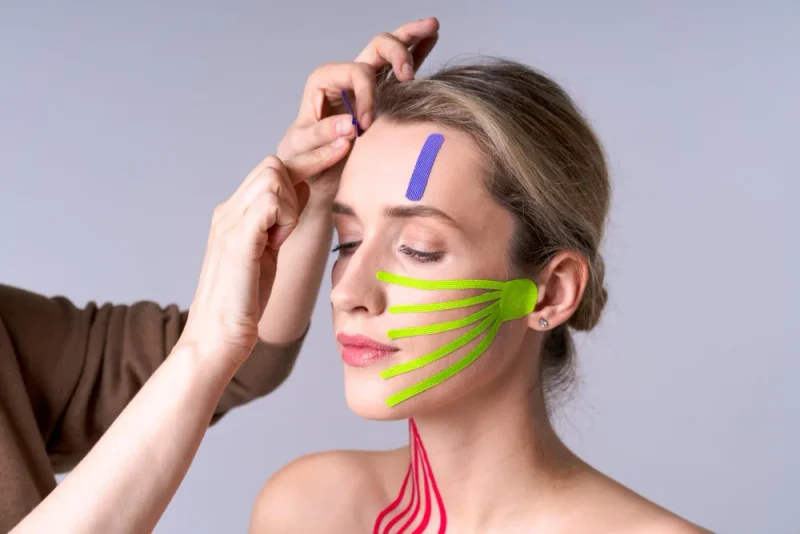
Face tape is specifically applied to areas like the forehead, cheeks, or other facial regions to mechanically hold the skin in place while worn.
What is Face Taping and Why is it Gaining Popularity?
In face taping, specialized adhesive strips are placed on selected facial areas, commonly targeting the forehead, the space between the eyebrows, the cheeks, or the skin around the mouth.
The method aims to prevent the skin from folding excessively during sleep or to create awareness of certain facial movements. Some users opt to wear the strips for just a few hours, while others prefer to keep them on overnight.
The idea isn’t entirely new; the temporary fixation of facial skin with adhesive strips has been around long before the rise of TikTok and Instagram. What is new, however, is the rapid dissemination of face taping as a supposed anti-aging hack.
Videos frequently showcase a smoother forehead or less noticeable lines immediately after tape removal. This dramatic before-and-after effect makes the technique particularly appealing on social media.
The current excitement aligns with a broader beauty movement that favors simple, non-invasive methods. Face yoga shares this philosophy but focuses on targeted exercises rather than mechanical skin fixation.
Unlike professional treatments, face taping requires only a few adhesive strips, making it an attractive option due to its low barrier to entry. However, a short-lived visible effect should not be mistaken for a lasting change in skin condition.
Additionally, terminology surrounding face taping can be confusing, as face tape, facial tape, and kinesiology tape are sometimes used interchangeably. Kinesiology tape was originally designed for different applications and is not necessarily suitable for delicate facial skin. Those interested in face taping should pay close attention to the material, adhesive, and manufacturer guidelines.
Does Face Taping Really Work Against Wrinkles?
Yes, face tape can make wrinkles appear less visible temporarily. However, there is no compelling evidence for permanent wrinkle reduction.
The explanation for this immediate effect is rather simple: the skin is flexible, and the tape can hold it in a specific position for a limited time. When an area is less folded or mechanically fixed for hours, it may appear smoother upon removal.
According to the Cleveland Clinic, face taping is a temporary solution. Dr. James Newman, a plastic facial surgeon, explains that while the tape can shape the skin, the effect does not last after removal. Wrinkles will reappear as the skin and underlying structures resume their normal movements.
This distinction is particularly important for expression lines, as forehead wrinkles or frown lines result from repeated facial muscle movements. While tape can limit movements during wear or remind individuals to relax certain muscles, this mechanical restriction disappears once the tape is removed.
Skepticism is warranted regarding claims that face tape can significantly boost collagen production, permanently tighten skin, or train wrinkles away. Such broad anti-aging assertions lack a solid data foundation.
It is essential to note that not all visible changes are purely psychological. For those waking with pronounced sleep lines, taping the affected area can yield noticeable differences.
The critical factor lies in the duration of the effect. Thus, face taping should be regarded more as a temporary beauty trick rather than a long-term solution for skin aging.
For effective long-term skin care, more established methods are recommended. The American Academy of Dermatology advises daily broad-spectrum sunscreen with at least SPF 30. Moisturizers can help plump fine lines, while UV protection helps prevent premature signs of aging.
Where is Face Tape Applied?
Not every facial area is taped for the same reason. Forehead taping is particularly common, as horizontal forehead wrinkles are significantly influenced by facial expressions.
Tape is also used between the eyebrows to keep the frown line area as still as possible during wear. Other applications include the cheeks, mouth area, or the sides of the eyes.
Extra caution is warranted around the eye area, where the skin is thin and sensitive. Strongly adhesive strips or abrupt removal are not advisable. The same caution applies to already irritated, very dry, or damaged skin.
| Area | Reason for Taping | Expected Effect | Precautions | |--------------|--------------------------------------------|----------------------------------------|-------------------------------------------| | Forehead | Limit movement and forehead wrinkles | Temporarily smoother skin appearance | Avoid taping under strong tension | | Frown Line | Reduce contraction between the brows | Lines may appear less prominent | Maintain distance from eyes and brows | | Eye Area | Visually influence fine lines | Temporary effect only | Extremely sensitive skin | | Cheeks | Mechanically fix skin | Possible short-term tightening effect | Do not confuse with medical lifting | | Mouth Area | Influence movement and sleep lines | Potentially less visible lines | Protect the sensitive mouth area | | Jawline | Often promised optical "lifting" | Mechanical effect during wear | No proven permanent contouring |
A current trend on social media involves positioning tape to create an upward pull on facial areas, producing a noticeable lifting effect in photos. However, this should not be confused with actual tissue tightening. Once the pulling force is removed, the skin will revert to its original position.
Furthermore, the idea that stronger tension yields better results is misleading. The face is not a fabric that can maintain shape through vigorous pulling. Excessive tension can become uncomfortable and further stress the skin.
How to Apply Face Tape Safely
Those interested in face taping should not use just any tape. A product should be explicitly designed for skin application or suitable for the intended area according to manufacturer guidelines.
Particularly for sensitive skin, it is advisable to test a small area first. Even products marketed as skin-friendly or hypoallergenic can provoke individual reactions.
The American Academy of Dermatology generally advises testing new skincare products on a small skin patch. This principle applies to face tape as well: if redness, burning, itching, or other noticeable reactions occur, the tape should not be used on the face.
Before applying, the skin should be clean and dry. Rich creams or oils can hinder tape adhesion.
Most importantly, do not aggressively stretch the skin while applying. The goal is not to create excessive tension.
Here’s a simple approach to face taping:
- Gently cleanse and dry the face.
- Choose a tape suitable for the skin and read manufacturer instructions.
- Cut the tape to fit the desired area, if applicable.
- Relax the facial muscles.
- Apply the tape without excessive pulling.
- Wear it only as long as recommended by the manufacturer.
- Remove slowly and carefully, avoiding abrupt tearing.
Particular attention should be given to the existing skincare routine. Retinol and other retinoids, as well as acids, can irritate or sensitize the skin.
The American Academy of Dermatology warns against using multiple potentially irritating anti-aging products simultaneously, as irritations can worsen skin appearance. Therefore, if the skin is already compromised, it is best to postpone taping.
Also, wearing tape overnight does not automatically mean longer is better. Manufacturer guidelines should take precedence over general recommendations from social media videos. If the skin burns or itches under the tape, it should be removed.
Patience is required when removing the tape. Pulling too hard can stress the outer skin layer. The Cleveland Clinic notes that tape can affect the outer horn layer, and the adhesive can cause dermatitis, irritation, or allergic reactions.

What Are the Risks of Face Taping?
Adhesive strips may seem less invasive than many other beauty methods at first glance. However, the material comes into direct contact with the skin for extended periods.
Redness, itching, irritation, and contact reactions are common concerns.
Frequent application and removal can be particularly problematic, as this repeatedly subjects the same skin area to mechanical stress. This can be uncomfortable if the skin is already dry or irritated. Additionally, highly aggressive adhesives are unsuitable for sensitive facial skin.
The Apotheken Umschau reviewed the beauty tape trend in April 2026, providing a medical and pharmaceutical perspective on its limitations and risks.
The key takeaway: the simple solution to wrinkles suggested on social media should not be confused with sustainable skin changes.
Caution is especially advisable for individuals whose skin already reacts sensitively to cosmetic products. This applies to those with existing skin concerns or a compromised skin barrier. Anyone receiving dermatological treatment for a skin condition should refrain from independently incorporating face taping into their regimen.