
Who Really Decides What’s Flattering?
Exploring the concept of flattering clothing and its implications on women's body image, this article delves into the historical and societal pressures that shape our perceptions of beauty.
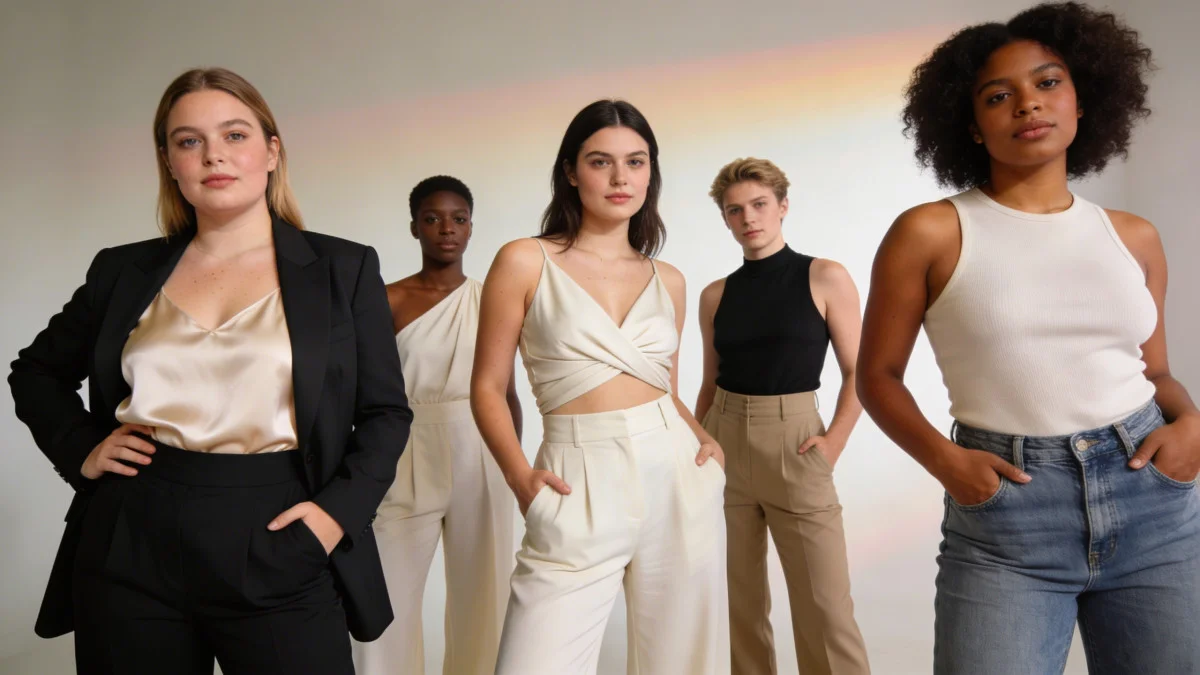
Entering a boutique, you might hear a sales associate say, "Ah, that one is very flattering for your silhouette." The term "flattering" rolls off the tongue, seemingly kind and supportive. Yet, upon closer examination, it raises an uncomfortable question: flattering according to what standard, and for whom?
Beneath this seemingly innocuous vocabulary lies a well-established mechanism that teaches women from a young age that their bodies need correction, balance, refinement, or concealment. Certain shapes are to be accentuated while others are minimized. Dressing becomes primarily a matter of optical strategy aimed at conforming to an ideal that no one truly selected.
The Political Nature of the Term "Flattering"
When fashion magazines or stylists assert that a cut "flatters" your figure, they imply two things: first, that an ideal silhouette exists, a reference model that the garment should help you resemble more closely. Second, they suggest that your body, as it is, is not sufficient on its own.
This is not mere linguistic coincidence; it is the result of a long history. Mona Chollet, in her essay Beauté fatale, articulates this clearly: the fashion and beauty industries subtly perpetuate a logic that keeps women in a constant state of anxiety regarding their appearance. Naomi Wolf succinctly summarized this dynamic with her statement: "A society obsessed with women's thinness is not a society fascinated by beauty, but by obedience."
What is presented as a well-meaning suggestion, "this style is more flattering," is, in fact, a disguised directive. It tells us what our bodies should look like instead of asking how we would like to feel in our clothing. The accessible fashion industry is evolving positively. Searching for a women's clothing brand like BZB is already a choice that prioritizes style without imposing an ideal silhouette.
The Origins of the Idea That Women’s Bodies Need Correction
The history of women's clothing largely reflects a narrative of body control. The 19th-century corset did more than support posture; it physically reshaped the torso, compressed organs, and made breathing difficult. The symbolic message was clear: a respectable woman fits into a specific silhouette. Her body must not overflow, either literally or figuratively.
In the early 20th century, Paul Poiret broke away from the corset in his collections, proposing high-waisted dresses inspired by ancient tunics. This was a small revolution, yet it remained the privilege of a minority. The following decades oscillated between partial liberations and new mandates. The 1920s freed the waist but prescribed an androgynous thinness. The 1950s celebrated curves but confined them in girdles. The 1990s introduced the "heroin chic" ideal. Each era promised freedom but accompanied it with new constraints.
What changes in these cycles is not the underlying logic but the target body; the female form remains a project to be realized, a site to be optimized. Fashion continually dictates how to align oneself with the current ideal. The vocabulary of "flattering" serves as one of the tools in this transmission.
The Tyranny of Body Types: Dressing as a Duty of Correction
Morphology guides present this obligation in seemingly practical and kind language. Are you pear-shaped? Balance your silhouette with structured shoulders. Are you rectangular? Create the illusion of curves with a cinched belt. Are you curvy? Opt for cuts that slim your figure.
The issue is not that these tips are useless. For many women, understanding how certain cuts interact with their bodies is valuable information. The problem lies in the underlying assumption: that there exists an ideal silhouette towards which all others should strive. The hourglass figure, with balanced shoulders and hips and a defined waist, remains the ideal ghost haunting every morphology advice. Everything else is framed as a deviation to be corrected.
Julien Magalhães, a fashion history expert, articulates it clearly: over the centuries, it has not just been bodies constrained by clothing, but the morality of women that has been attempted to be contained within garments. The cut is never neutral; it conveys what is acceptable, desirable, and respectable.
Body Positivity: Progress and Limitations
Since the 2010s, the body positivity movement has significantly challenged this paradigm. Its central assertion is straightforward: all body types deserve visibility, style, and respect. Tall, short, curvy, thin, with or without visible disabilities, every silhouette has the right to exist in public spaces and fashion media.
Some brands have begun to expand their size ranges, diversify their casting, and showcase stretch marks, scars, and bodies that do not conform to traditional standards. For many women, seeing a body that resembles theirs in a fashion campaign has been a truly liberating experience.
However, body positivity has also been co-opted. Some brands use it as a marketing tool without making substantial changes to their practices. Featuring a plus-size woman in an advertisement does not prevent that same brand from only offering sizes 34 to 42. Moreover, the pressure to "love oneself" can quickly become an additional burden: not only must you conform to aesthetic norms, but you must also embrace them enthusiastically and display your fulfillment.
The movement has opened an important breach, but it has not yet dismantled the entire system.
The Impact of TikTok on Body Image
Social media, particularly TikTok, has amplified both the pressures and the spaces for resistance. On one hand, the platform endlessly circulates ultra-fast trends that constantly redefine what is "in" or "out." The "coastal grandmother" trend follows the "cottagecore," which precedes the "clean girl aesthetic": each micro-trend comes with its own implicit dress code, and thus its own underlying ideal body type. Fashion content creators continuously offer solutions to "optimize" one’s silhouette, with the vocabulary of flattering more prevalent and viral than ever.
On the other hand, TikTok has also allowed marginalized voices to emerge with unprecedented reach. Plus-size creators who reject camouflage advice and wear what they want, women documenting their relationships with their bodies without filters or forced positivity, and discussions around fatphobia and ableism in fashion are finding a genuine audience. Such content existed before but remained on the fringes. The algorithmic mechanics can now elevate them to the same level as conventional style tutorials.
The outcome is a contradictory cacophony: never have the pressures been so numerous and rapid, yet never has the resistance to these same pressures been so visible and organized.
What’s Next?
The question is not to declare that style advice is inherently harmful or that an interest in fashion is a weakness. Style is a legitimate pleasure, a form of personal expression, and sometimes a game. The issue arises when it becomes a moral obligation: when "dressing according to your body type" shifts from being an option to an implicit duty.
Reframing the question of "for whom?" is simple to articulate yet challenging to enact. Dressing to affirm your own relationship with your body, rather than to correct it in the eyes of others, is key. Wearing what brings pleasure, comfort, or confidence, regardless of whether it "flattens" according to inherited criteria, is crucial.
This does not mean ignoring all style suggestions but filtering them differently. Morphology advice can be useful if viewed as information: "This cut often works like this on this type of silhouette." It becomes toxic when it is prescriptive: "If you have this body, you must wear this to appear acceptable."
As Rei Kawakubo of Comme des Garçons expressed in her 1997 collection "Body Meets Dress, Dress Meets Body": clothing can embody the body, and the body can embody clothing. This statement was political and remains relevant today.
Dressing for Yourself: A More Radical Act Than It Seems
At the heart of the discussion surrounding flattering clothing lies a deeper question: who owns the gaze directed at our bodies? For a long time, this gaze has been predominantly external, male, and normative. It has dictated what is beautiful, what is acceptable, and what deserves to be seen.
Every time we choose an outfit because we like it rather than because it "flatters" according to those criteria, we perform a small act of rebellion. While it may not be enough to overturn an industry, it is sufficient to begin shifting the gaze inward, where the only question that truly matters is: do I feel good in this?
And if the answer is yes, perhaps the rest doesn’t need to decide for us.
![Upcoming Episode of 'Ici tout commence': What to Expect on July 28, 2026 [SPOILERS]](https://glowculturehub.com/cdn/images/ed4be09127bac48e6cdfdef85066b1c3/w1200.webp)