
Advancing Aesthetic Medicine: The Role of Biological Priming in Facial Rejuvenation
Exploring the role of amino acid-based tissue preparation in facial rejuvenation, emphasizing biological priming as a key factor in aesthetic medicine.
Advancing Aesthetic Medicine: The Role of Biological Priming in Facial Rejuvenation
- 16th July 2026
- Thierry PIOLATTO
Dr Yuliya Diedyk-Gusarova
Exploring the Importance of Amino Acid–Based Tissue Preparation in Rejuvenating Facial Aesthetics
Traditionally, aesthetic medicine has focused on volumisation: identifying and filling deficits to restore facial contours. However, this method often neglects a critical biological factor—the ability of aging skin to integrate and sustain aesthetic enhancements is largely influenced by the metabolic health of the dermal matrix.
Understanding the Biological Vulnerability of Aging Skin
Aging skin is characterized by a gradual failure of the extracellular matrix (ECM), which is primarily driven by the natural aging of fibroblasts and external environmental factors. As fibroblasts age, they develop a senescence-associated secretory phenotype (SASP), which results in an increase of pro-inflammatory cytokines and matrix metalloproteinases. This creates an environment that is not conducive to regeneration. Additionally, factors such as UV exposure exacerbate the degradation of collagen and elastin, while hormonal changes post-menopause contribute to collagen loss at a rate of approximately 1–2% per year. In such a biologically compromised environment, the longevity of fillers may vary significantly, influenced by the integrity of the ECM and its regenerative capacity, beyond just technical aspects.
The Role of Substrate Availability in Collagen Production
Collagen synthesis requires adequate intracellular substrates. The structure of fibrillar collagen, characterized by the repeating Gly–X–Y sequence, depends on sufficient levels of glycine, proline, and lysine, along with essential nutrients like vitamin C, iron, and α-ketoglutarate for proper hydroxylation and stabilization of its triple-helix structure. Under conditions of increased turnover, proline becomes conditionally essential, and lysine must be obtained from external sources. Insufficient hydroxylation can lead to reduced cross-linking density, which is crucial for collagen's tensile strength. Thus, ensuring substrate availability is a necessary biochemical condition for effective collagen assembly and is influenced by a broader network that includes fibroblast aging, oxidative stress, and altered cellular signaling.
Introducing Amino Acid Priming: Rationale and Methodology
Amino acid-based tissue priming involves the intradermal delivery of key amino acids—glycine, proline, and lysine—to meet the structural requirements for collagen biosynthesis. Leucine is added to activate the mTOR pathway, promoting anabolic signaling rather than acting as a direct collagen precursor. Additionally, non-cross-linked high-molecular-weight hyaluronic acid (HMW-HA) serves as a biophysical conditioner, enhancing dermal hydration and elasticity without contributing to volumetric expansion. Treatment protocols typically consist of multiple intradermal sessions spaced three to four weeks apart, with structural interventions postponed for about two weeks following the completion of amino acid priming. Observational studies have linked this approach to improvements in skin hydration, elasticity, and overall quality, although further validation through randomized controlled trials is necessary.
Integrating Clinical Practices: Prioritizing Biological Factors
The biological priming paradigm shifts the treatment focus to address metabolic and biosynthetic deficiencies before implementing structural corrections. Patient evaluations should include assessments of hydration levels, skin elasticity, and systemic factors such as hormonal status and medication use. This comprehensive approach applies to energy-based and surgical interventions as well, which rely on fibroblast health, ECM organization, and effective wound healing. By optimizing the dermal metabolic environment, the reparative capabilities across various treatment modalities may be enhanced. Amino acid-based tissue preparation stands out as a scientifically sound preparatory strategy that deserves thorough examination within the framework of evidence-based aesthetic medicine.
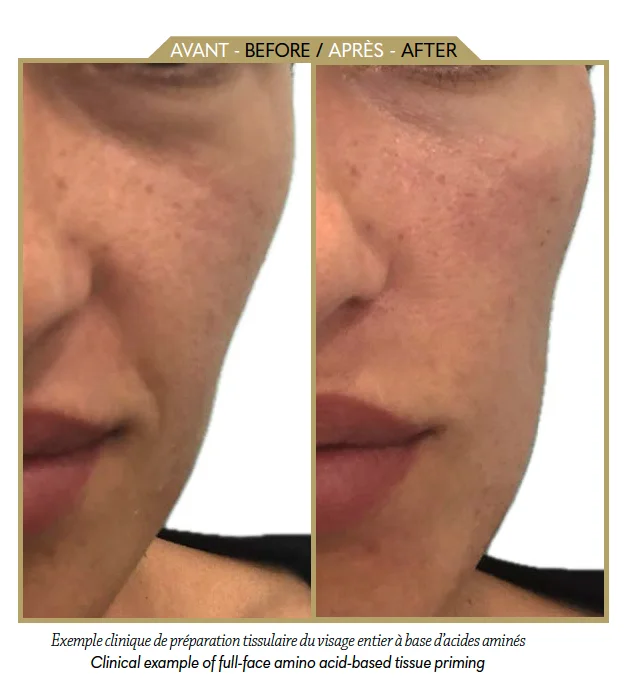
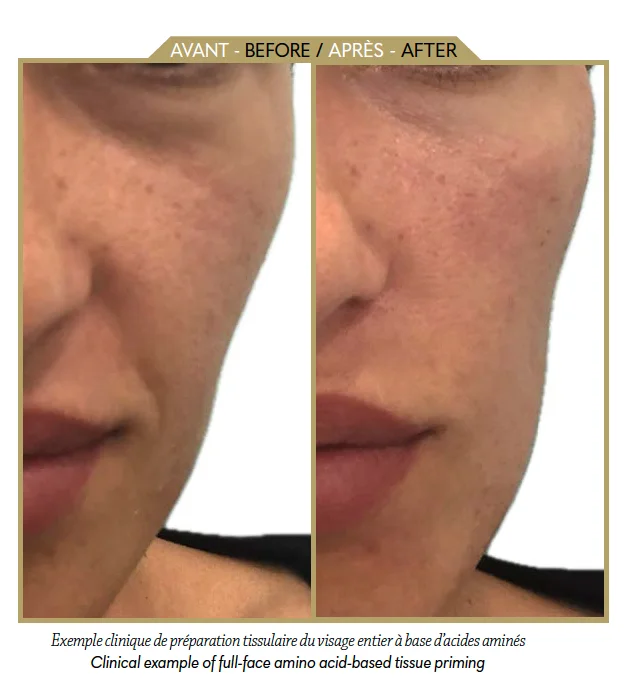
A 41-year-old female patient underwent three sessions of intradermal amino acid-based dermal priming at two-week intervals (glycine, proline, lysine, leucine, and non-cross-linked HMW-HA). Clinical photographs illustrate her baseline appearance (left) and the results three weeks after completing the treatment (right). No additional procedures were conducted during this timeframe, and images were captured under consistent lighting and positioning without digital alteration.
Dr Yuliya Diedyk-Gusarova

MD — Maxillofacial Surgeon, Aesthetic Physician, and Founder of DrJ Clinic London and DrJ Academy.