Exploring Martin McDonagh's Cinema Through Two Films
Martin McDonagh's films explore the dilemma of staying or leaving through complex characters and dark humor, as seen in _In Bruges_ and _The Banshees of Inisherin_.
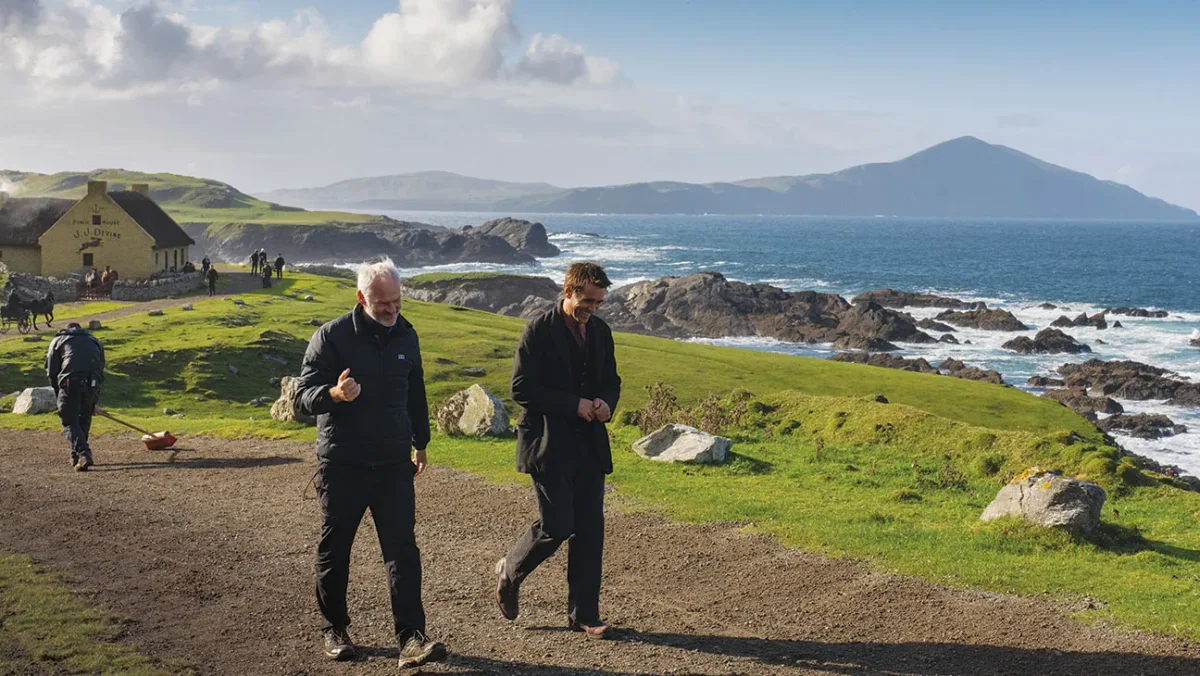
The theme of staying or leaving resonates deeply within the characters crafted by Martin McDonagh. As their paths intertwine in search of favorable outcomes, one conclusion remains evident: escape from Bruges!
Since the release of In Bruges in 2008, which introduced him to a wider audience, the Brit-Irish director and screenwriter Martin McDonagh has established himself as a master of dark comedy. Beyond his unique tone, a shared reflection and philosophy permeate his films, impacting each character he creates: the dilemma of whether to stay or leave.
Escape from Bruges!
In In Bruges, the answer seems clear for Ray (Colin Farrell), a hitman: he must flee Bruges at all costs! However, this desire to escape transcends mere geography; Ray is actually trying to escape from who he has become. Bruges, the city where his boss has sent him to lay low after the accidental killing of a child, mirrors a life he can no longer bear.
_"I know I didn’t mean to… but because of the choices I made, and the course that I put into action, that little boy isn’t here anymore, and he’ll never be here again. I mean here in the world, not here in Belgium. Well he’ll never be here in Belgium either, will he? I mean, he might’ve wanted to come here when he got older. Don’t know why. And that’s all because of me. He’s dead because of me. And I’m trying to… been trying to get me head around it, but I can’t. I will have always have killed that little boy. That ain’t ever going away. Ever. Unless… maybe I go away."
Ray's rejection of his current state is starkly contrasted by his companion, Ken (Brendan Gleeson), who seems to thrive in the Belgian city, enjoying every cultural visit from museums to cathedrals. Ken’s acceptance of his profession as a hitman, rather than viewing it as a curse, highlights the ongoing theme of duos in McDonagh's work, where the tension between those who embrace their environment and those who reject it is a constant.
Throughout the film, Ray's attempts to escape are evident. Initially, he seeks to end his life, but this effort fails. He then tries to escape emotionally through his connection with Chloë (Clémence Poesy), distancing himself from Ken and his criminal activities. Yet, the limits of this escape are made clear when Chloë's boyfriend threatens Ray with a gun.
Later, dissatisfied with these limited avenues, Ray attempts a geographical escape by taking a train to leave Bruges. Yet again, the boundary proves significant: he is arrested on the train after being reported by a restaurant patron he had previously assaulted. This moment underscores a crucial point: in his desire to flee, Ray also constructs his own barriers. He must confront the consequences of his past actions, and this struggle represents the fundamental divide between his current life and the escape he desperately seeks. Ultimately, Ray must experience death to attain the escape he craves, accepting both his current existence and the life he wished he could have had. In the end, fleeing Bruges—deemed hellish in a final line—becomes a cathartic escape that encapsulates the complexities of his existence within a mere 101 minutes.
In contrast, Ken meets his end in Bruges, sacrificing himself by jumping from the cathedral to save Ray from certain death. This act symbolizes his commitment to staying—not just in Bruges, where he dies at the foot of the city's iconic monument, but also in alignment with his life choice as a mentor and hitman. His final act is one of selflessness, abandoning his life to save Ray's.
The character of Harry (Ralph Fiennes), the boss of the two hitmen, serves less as a protagonist with free will and more as a structural element in the narrative, representing the boundary between staying and leaving. Throughout the film, he legitimizes the beauty of Bruges, describing it as a "fairy-tale city," which mentally frames the city as a place not conducive to escape.
In the latter half of the film, Harry intervenes directly to eliminate any chance of escape, going so far as to kill Ken and attempt to kill Ray to achieve his goals. His character exacerbates the significance of the boundaries that Ray must navigate to find his way out.
The Banshees of Inisherin: A Life of Regret
In The Banshees of Inisherin (2022), set on a small Irish island in the 1920s, Colm (Brendan Gleeson) abruptly stops speaking to his best friend Padraic (Colin Farrell). This leads to a confrontation between the two men.
The theme of escape is even more pronounced here, as the film revolves around a triangle formed by Colm, Padraic, and Siobhán (Kerry Condon), Padraic’s sister.
Padraic embodies a naive attachment to the status quo, as seen in one of the film's early scenes where he cheerfully strolls through the harbor while civil war rages in the distance. When Colm confronts him about his perceived mediocrity, Padraic is offended, unable to grasp the reason for the conflict. He represents a desire for a simple life, finding joy in mundane moments like enjoying a beer at the pub or tending to his animals. Colin Farrell’s portrayal of Padraic is that of a man content with the everyday.
Colm, on the other hand, exhibits a partial desire to escape. The film develops the growing conflict between him and Padraic regarding their daily lives. While Padraic yearns for simplicity, Colm, older and weary of trivial conversations, seeks stimulation beyond the confines of their small village. He finds solace in music, which allows him to explore a different facet of himself as a musician and composer, engaging with a diverse group of fellow musicians. Yet, Colm's desire to leave is only partial; he acknowledges that while he wishes to distance himself from Padraic's stagnation, he ultimately chooses to "stay" in his life on the Irish moors of Inisherin.
In contrast, Siobhán embodies the full desire to escape a dull life that she did not choose, which limits her intellectual and social aspirations. Throughout the film, the gap between her and the local populace widens, with growing hostility becoming increasingly palpable. Like Colm, Siobhán faces limitations imposed by her surroundings and her connections, particularly with her brother Padraic, who is left more isolated due to his recent fallout with his best friend.
Unlike Colm, however, Siobhán successfully crosses this boundary, both physically and metaphorically, as the island is surrounded by the sea, making her journey from Inisherin to the mainland all the more tangible.
This triangular dynamic is firmly rooted in a territory that feels almost like a character in its own right, promoting an inertia that resists change. The island's cyclical life, marked by cannon fire from the opposing shore, seems devoid of excitement. This is emphasized by the long, empty paths the characters traverse, which remain strikingly similar and devoid of distinction. Events on the island also reinforce this theme; early in the film, a police officer informs a local merchant that a twenty-nine-year-old man has drowned nearby.
_"Fella killed himself, o’er Rosmuck way. Walked into a lake for himself. Twenty-nine and nothing wrong with him, the fool."
Notably, twenty-nine is the age of Barry Keoghan, who plays Dominic in the film, a troubled young man close to Padraic, and who ultimately meets the same fate as the one previously announced.
This repetition of similar events fuels the notion that Inisherin is an island stuck in a loop, where youth, disillusioned, cannot find its place, while only the elders seem to thrive. Siobhán recognizes this at the moment she decides to leave.
Furthermore, the presence of the "banshees," creatures from Celtic folklore who predict death, manifests as elderly women dressed in black wandering the island, appearing at key moments in the narrative. They seem to symbolize the guardians of the current social state, their age accentuating a conservative aspect that obstructs progress, personified by Siobhán.
The climactic confrontation between Colm and Padraic unfolds under the watchful eyes of these banshees, emphasizing the culmination of the geographical and social boundaries of the island. As the two characters face the sea beneath an open sky, it initially appears they have finally attained true freedom.
You may also like