
Signs of Failed Hair Extensions: How to Spot Them Early
Learn how to identify signs of poorly applied hair extensions, including persistent pain, visible irritation, and tangling issues, to avoid further damage.
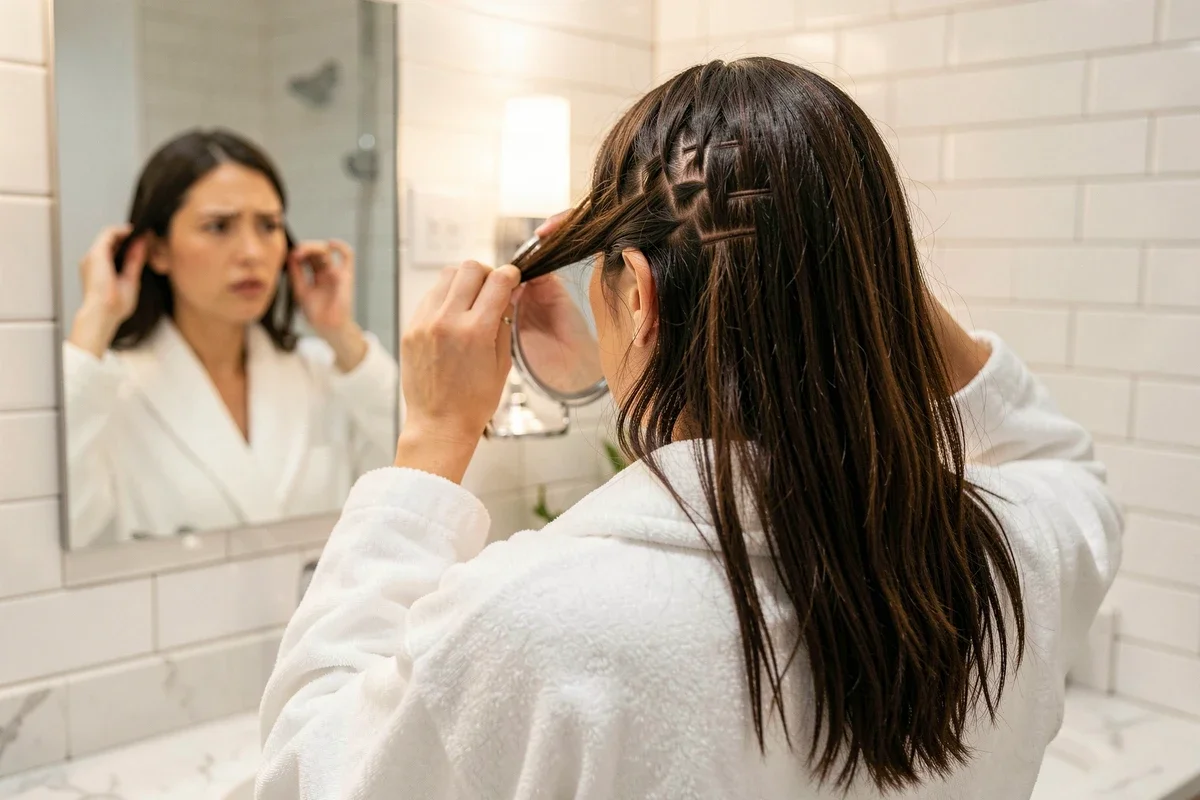
If you've just had hair extensions applied and something feels off, you are not alone. The reflection in the mirror may not match your expectations, or worse, you might be experiencing persistent discomfort on your scalp. Evaluating the before and after of your hair extensions is not just about admiring the transformation; it’s also crucial for identifying potential issues before they lead to more significant damage.
Persistent Pain After Extension Application: A Red Flag
It’s common to experience slight tension in the hours following the application of hair extensions as your scalp adjusts to the added weight and attachment points. However, pain or headaches that last beyond 48 to 72 hours are not normal.
This prolonged pain is indicative of a mechanical problem. The extensions may be too tight or excessively heavy for your natural hair density, placing undue stress on your roots. If you find yourself relying on painkillers nightly due to your extensions, it's time to have the application corrected. Continuous excessive tension can lead to traction alopecia, a condition characterized by hair loss resulting from repeated mechanical stress on the follicles. The most affected areas are typically the temples and the hairline, where hair is naturally finer.
Visible Signs on the Scalp: Redness, Bumps, and Itching
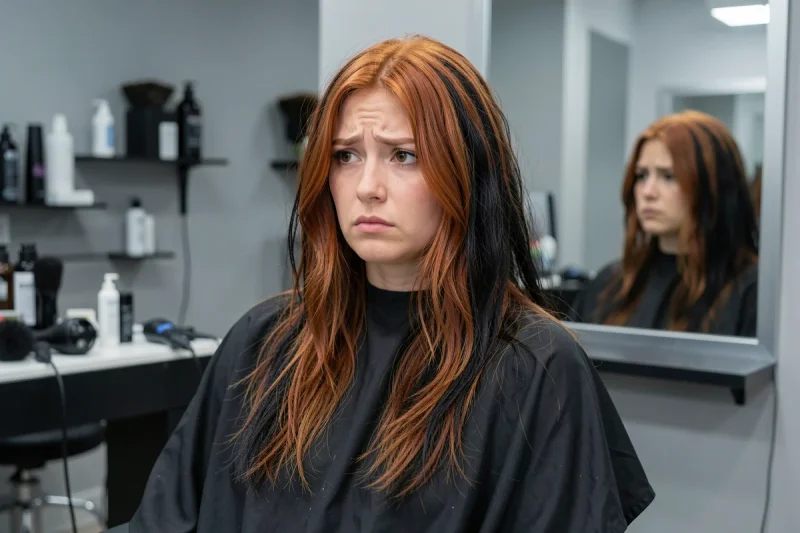
Before-and-after galleries online rarely focus on the scalp, yet this area is critical for assessing the success of an extension application. Have you noticed localized redness around the attachment points?
Redness, bumps, or itching concentrated around the attachments are signs of mechanical irritation. In some cases, this could indicate folliculitis, an inflammation of the hair follicles caused by friction or the weight of the extensions.
Be vigilant for these dermatological signals in the days following your application:
- Red patches or small white bumps around keratin points, rings, or adhesive strips.
- Persistent localized itching that doesn’t subside after gentle shampooing, especially if it occurs solely at the attachment sites.
- A burning sensation when touching certain strands, indicating that the attachment is compressing the scalp.
These symptoms are not part of an adjustment period; they suggest that the installation is exerting abnormal pressure or that the adhesive material is irritating your skin.
Extensions That Are Visible or Misplaced: What the Mirror Reveals
The simplest test requires no technical skills. Pull your hair into a high ponytail or run your fingers along your nape. If the attachment points are clearly visible or feel prominent under your fingers, the placement is incorrect.
Spacing and Placement Line
A successful application positions the extensions at a sufficient distance from the roots and parting. The attachments should remain invisible when you move your head, even in windy conditions. If an adhesive strand protrudes when you lift your hair to the side, it has been placed too high or too close to the hairline.
Irregular Thickness Between Before and After
Examine your hair from the side. A proper application creates a uniform volume gradient. A “helmet” effect, with concentrated volume at the tips and a flat crown, indicates improper distribution of the number of strands or an unsuitable calibration.
For fine hair, the number of strands must be reduced to avoid overloading the roots. If the application was calibrated as if for thick hair, the excessive weight could accelerate hair loss and create a visible contrast between the top and bottom sections of your hair.
Extensions That Tangle After a Few Washes: Fiber Quality in Question
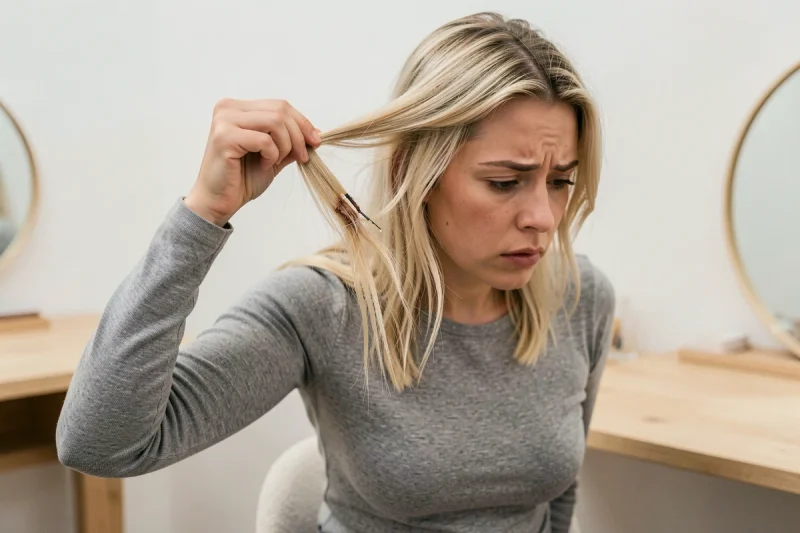
You may have initially compared the before and after of your extension application and found the result satisfactory. However, if two weeks later your extensions are forming tangles that are impossible to detangle, there are two potential causes.
The first is the quality of the hair fiber. Extensions with cuticles that are not aligned in the same direction will mechanically tangle when in contact with your own hair. Recurring knots within the first few weeks indicate poor-quality hair, not a lack of maintenance on your part.
The second issue relates to the attachment technique. Strands placed too close together will overlap and create clumps. This problem worsens at night, as head movements on the pillow increase friction.
To differentiate between the two causes:
- If knots form only at the attachment points, the issue is related to placement.
- If the tangles occur throughout the lengths, even far from the attachments, the fiber is likely at fault.
- If the problem arises suddenly after a change in shampoo, check that your product doesn’t contain harsh sulfates that can damage the keratin used in the attachments.
When to Remove Failed Hair Extensions
Do not leave a problematic application in place, hoping the situation will improve. An extension that pulls, irritates, or tangles will not stabilize over time; it will only get worse.
Removal should be performed by a professional. Attempting to remove keratin or adhesive extensions on your own risks pulling out natural hair and further weakening already stressed areas. A specialized hairstylist will use an appropriate solvent for the attachment technique, minimizing breakage.
After removal, allow your hair to rest for several weeks before considering a new application. Request a hair diagnosis beforehand: assessing hair thickness, natural density, and scalp condition is essential. This evaluation will determine the choice of technique, number of strands, and total weight of the extensions. Without this step, the risk of repeating the same mistakes remains high.
You may also like