
Understanding the Ending of Jurassic Park III
Jurassic Park III explores themes of survival and the relationship between humans and dinosaurs, culminating in a thought-provoking ending that challenges human arrogance.
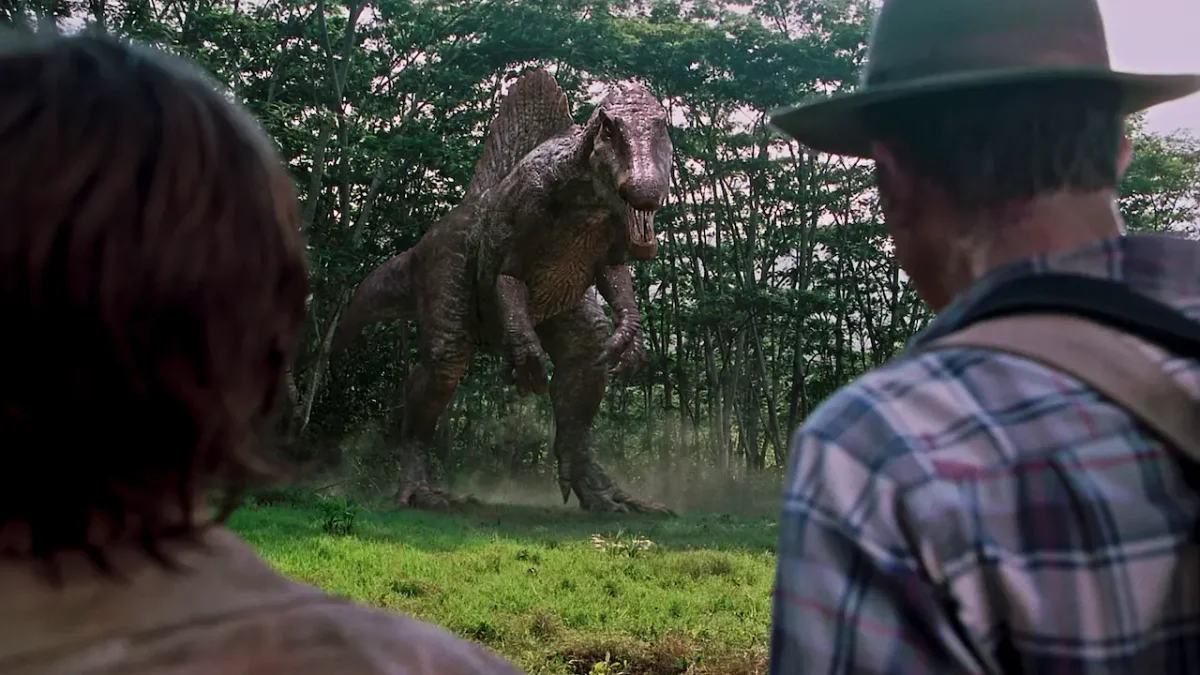
In 2001, Jurassic Park III faced a formidable challenge: to continue the legacy of its predecessors without the directorial vision of Steven Spielberg, who remained on board only as an executive producer. Joe Johnston opted for a different approach, crafting a film that unfolds as a brisk and intense adventure, primarily set on Isla Sorna. Beneath the thrilling chases, the narrative brings back the central character who initiated the saga, paleontologist Alan Grant, who is once again confronted with a world he thought he had left behind.
The film's conclusion, seemingly straightforward, encapsulates many themes that resonate throughout the original trilogy. The survival of the protagonists does not equate to a triumph over the island; rather, Jurassic Park III underscores that humanity remains an interloper in an ecosystem that has established its own rules. The final image of pterosaurs soaring freely over the ocean indicates that the issue extends beyond the characters' survival—it touches upon the future of the relationship between humans and dinosaurs.
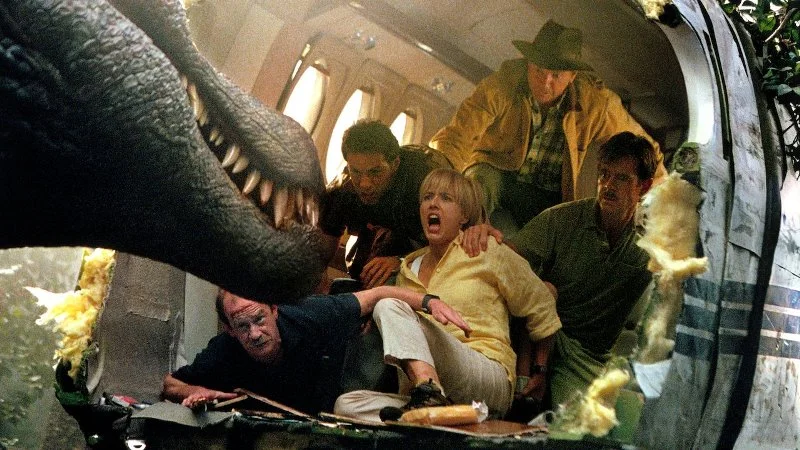
Joe Johnston Centers Alan Grant in a Tale of Survival
Unlike the two films directed by Steven Spielberg, Jurassic Park III largely abandons reflections on economic power and genetic manipulation to focus on the theme of survival. Joe Johnston, known for his adventure films, creates a fast-paced narrative where each sequence propels the characters toward new threats without allowing for narrative pauses.
This shift in perspective also allows Alan Grant, once again portrayed by Sam Neill, to take center stage. While in the first film he grappled with his relationship with children and nature, here he appears as a somewhat isolated scholar, striving to defend his research on Velociraptors against a public more interested in the spectacle of dinosaurs.
The journey to Isla Sorna is initiated by a deception orchestrated by the Kirby couple, but it quickly becomes an opportunity to showcase Grant's transformation. His scientific knowledge remains crucial; however, the film consistently emphasizes that even the most knowledgeable expert cannot truly control an environment governed by its own logic. This return to the saga's roots suggests that knowledge is meant to understand the world, not to dominate it.
The Ending of Jurassic Park III: The Raptor Chase and Alan Grant's Rescue
The film's climax revolves around a mistake made by Billy Brennan, who steals Velociraptor eggs in hopes of selling them to fund Grant's research. This seemingly minor act triggers the pursuit that follows the protagonists for much of the story.
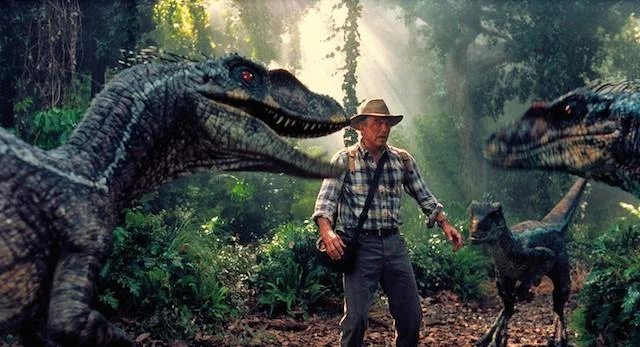
As the group finally reaches the coast, they appear to be on the brink of salvation. However, they are confronted by a pack of Velociraptors. This moment clarifies that the animals are not hunting humans out of predatory instinct; their true goal is to reclaim the stolen eggs.
Grant understands the situation and uses a vocal replicator built by Billy to study raptors' sounds. The noise produced by the device temporarily eases the tension, allowing the protagonists to return the eggs. Once the nest is restored, the pack retreats peacefully.
This narrative detail is significant. For the first time in the saga, the conflict with dinosaurs is resolved not through force, but through an understanding of their social behavior. Grant survives because he accurately interprets the animals' motivations, rather than viewing them as mere killing machines.
Shortly thereafter, helicopters from the Marines and the Navy arrive, alerted by Ellie Sattler thanks to a call made with a satellite phone recovered from the stomach of the Spinosaurus. Even Billy, believed dead after an attack by Pteranodon, is found alive and rescued, completing the group's reunion.
Dinosaurs Challenge Human Arrogance
One of the most intriguing aspects of the ending is how Jurassic Park III portrays dinosaurs. From the very first film, the saga has emphasized the folly of viewing these creatures merely as monsters. This film takes that concept further.
The Velociraptors display memory, social organization, communication skills, and a strong sense of group protection. All of Alan Grant's research, often dismissed by his funders, finds validation in the events that unfold on the island.
Even the Spinosaurus, introduced as the new primary antagonist, acts according to territorial dynamics rather than blind aggression. Each confrontation arises from the invasion of its territory or the repercussions of human actions. The island is not merely an amusement park gone awry; it has evolved into a functioning ecosystem that reacts to human presence like any natural environment.
In this light, the theft of the eggs takes on symbolic significance. Billy views the eggs as an economic opportunity, while the raptors defend them as any species would. Once again, human greed leads to crisis.
Pterosaurs Soaring: A Sign of Diminishing Human Control
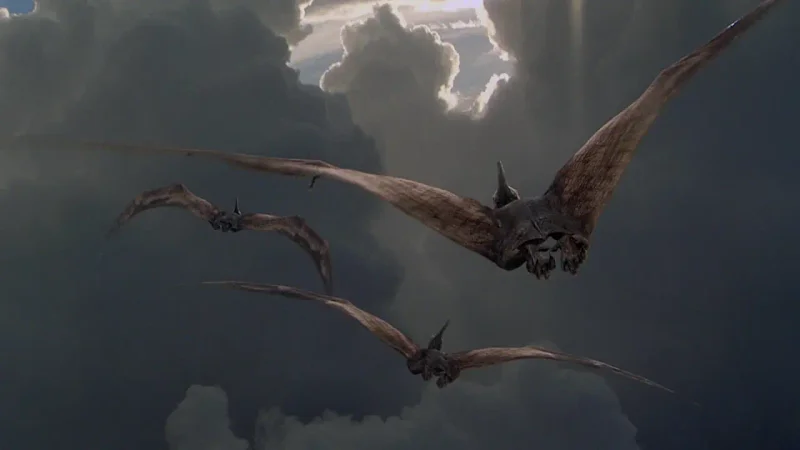
The film's final shot features Pteranodon gliding alongside helicopters departing Isla Sorna. This brief image likely represents the most crucial moment of the entire conclusion.
Until that point, dinosaurs had been confined to the islands created by InGen, isolated from the rest of the world. The sight of pterosaurs flying over the ocean suggests that these boundaries are becoming increasingly tenuous. The artificially recreated nature is slowly beginning to escape human containment.
This foreshadows significant developments in the saga, particularly in Jurassic World, where coexistence between humans and dinosaurs becomes inevitable. In Jurassic Park III, this idea is hinted at without becoming the central narrative element, leaving the audience to ponder the potential consequences.
Simultaneously, this sequence marks a turning point for Grant. The man who always viewed dinosaurs as mere fossils now witnesses them living, reproducing, and claiming their space in the world. His scientific perspective undergoes a profound transformation.
The True Meaning of Jurassic Park III's Ending: Nature Cannot Be Reversed
The conclusion of Jurassic Park III avoids dramatic twists, as its aim is different. The true resolution lies in the transformation of the characters’ perceptions of dinosaurs and, more broadly, the relationship between humanity and nature.
Alan Grant departs the island with a newfound understanding compared to his initial arrival. His theories on the intelligence of Velociraptors are validated through firsthand experience, illustrating that genuine science arises from observation and comprehension, not from sensationalism.
The final rescue also carries a specific meaning. The military manages to recover the survivors, but they do not reclaim the island. No one attempts to eliminate the dinosaurs or regain control of the territory. The ecosystem continues to exist independently of human presence.
Thus, the last image of Pteranodon remains etched in memory. As humans return to civilization, the animals continue their journey, free to occupy the skies beyond the boundaries humanity believed it could impose. This serves as the ultimate affirmation of the idea that permeates the entire saga: once the balance of nature is altered, there is no way to truly turn back time.
You may also like
![Ici tout commence: What to Expect in Episode 1488 on Monday, July 27, 2026 [SPOILERS]](https://glowculturehub.com/cdn/images/b2d3d6d788c39a22a548df320e6d9f77/w1200.webp)