Baby Teeth: How to Manage Brushing Without Ending Up in a Panic (and with Zero Cavities)
Establishing a brushing routine as soon as the first tooth appears is the best gift you can give to your child's future smile. Let's review the latest official recommendations to protect their smile without sacrificing your mental health.
Establishing a brushing routine as soon as the first tooth appears is the best gift you can give to your child's future smile. Let's review the latest official recommendations to protect their smile without sacrificing your mental health.
The Ritual Begins with the First Little Baby Tooth
Forget the idea of waiting for your child to have a complete set of teeth before bringing out the big guns. As soon as that first little white tip breaks through the gum, usually around six months, the match begins. At this age, the enamel is still ultra-thin, and acid attacks are merciless. The secret to avoiding early cavities is to establish an immediate routine: brushing twice a day, in the morning and especially at night. At night, saliva becomes scarce and no longer protects the teeth, leaving the field open for bacteria.
For starters, there's no need to invest in a complex gadget. A small soft-bristled toothbrush or even a damp cloth to massage the gums is more than sufficient. The goal is twofold: to clean, but also to familiarize the little one with this new sensation. The earlier the action is integrated, the less it will be perceived as an aggression later on.
Fluoride Remains Your Best Bodyguard
We hear everything and its opposite about fluoride, but experts from the UFSBD are clear: it is the number one shield against cavities. The golden rule can be summed up in one number: 1000 ppm. This is the recommended concentration of fluoride in toothpaste from six months for most children. What changes is the amount applied to the bristles. Before three years, a simple smear, like a grain of rice, is sufficient. Between three and six years, it increases to the size of a pea.
A tip that is often forgotten is to teach the child to spit out the excess toothpaste without rinsing their mouth with water. This allows the fluoride to remain in contact with the teeth and continue its strengthening work long after brushing is finished. If your child is at high risk for cavities, your dentist may even adjust these doses upward, sometimes reaching 1450 ppm as early as three years old.
Dental Autonomy is a Marathon, Not a Sprint
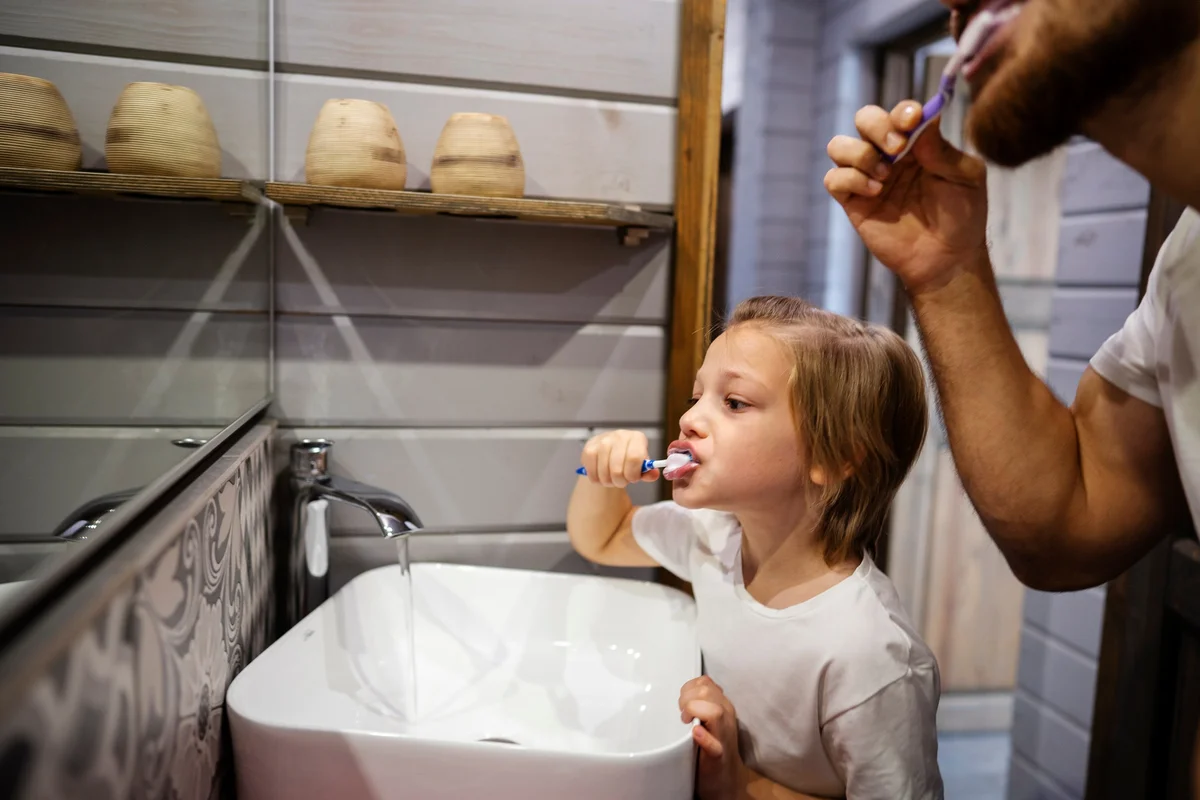
Even if your child screams that they want to do it alone, keep a firm hand on the brush. The fine motor skills needed to reach the back molars develop only later. In short, it’s the adult who brushes until the age of five, and who closely supervises until the age of eight. To keep this moment enjoyable, focus on mimicry by brushing your teeth at the same time as them.
Also, think about limiting the transmission of bacteria in daily life. Avoid cleaning the pacifier with your own mouth or sharing the same spoon to taste the puree. These seemingly harmless gestures transmit our bacteria to the fragile teeth of little ones. **Finally, don't forget the annual dentist appointment starting at one year: with the M’T Dents program, it’s free and helps to demystify the visit before a real problem arises.
You may also like