
Everything You Need to Know About the Offset Labret Piercing
The offset labret piercing, with its unique lateral placement, requires careful consideration of dental occlusion, facial morphology, and specific healing protocols. Learn how to ensure a successful piercing experience.

The offset labret piercing is distinct from the traditional labret due to its lateral placement beneath the lower lip. This unique positioning significantly alters the technical considerations for piercing, jewelry selection, and healing protocols. Here, we explore the aspects often overlooked by general guides.
Technical Considerations: Offset Labret and Dental Occlusion
The lateral placement of the offset labret brings the jewelry closer to the lower canines and premolars. This proximity necessitates a jewelry choice that is influenced by oral morphology rather than mere aesthetic appeal.
A short flat-back with a low-profile end minimizes friction against the enamel when teeth are near the inner lip. It is advisable to have your occlusion assessed by the piercer before finalizing the exact location of the piercing. A mere two-millimeter shift can prevent chronic contact between the teeth and the jewelry.
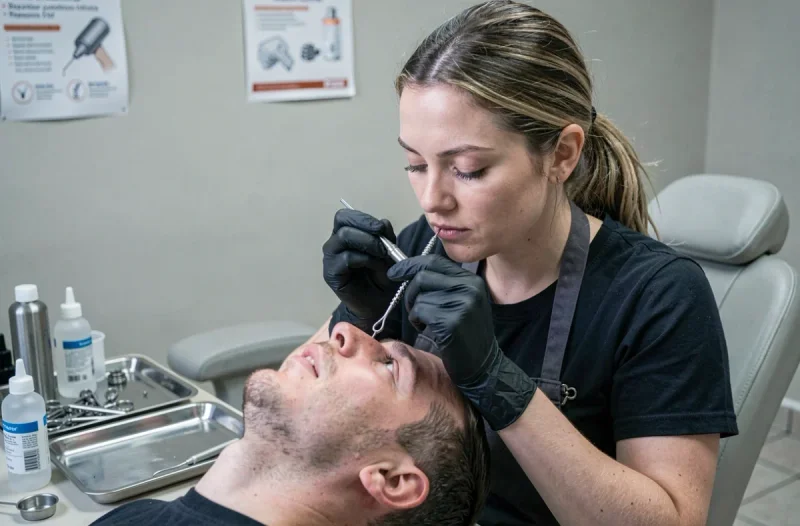
Personalized Piercing Placement Based on Facial Morphology
Successfully executing an offset labret piercing requires a nuanced understanding of the lower lip and chin. Factors such as lip shape, thickness, vermilion curvature, and chin projection determine the optimal piercing point.
For individuals with thinner lips, placing the piercing too low can create a drooping effect. Conversely, for fuller lips, positioning it too high can bring the jewelry too close to the vermilion, complicating the healing process due to constant friction. The ideal placement arises from careful marking tailored to individual anatomy, not from a one-size-fits-all approach.
It is recommended to ask the piercer to create several markers with surgical ink, allowing you to assess the appearance with both an open and closed mouth. The jewelry should look harmonious in both positions.
Choosing a Side: The Importance of Overall Symmetry
The decision regarding which side to pierce should consider existing facial piercings and the natural symmetry of the face. If a nostril piercing is already present, positioning the offset labret on the same side creates a cohesive vertical line. Conversely, positioning it on the opposite side can help balance facial volumes.
Jewelry Choices: Initial and Permanent Options for the Offset Labret
The initial jewelry is intentionally longer to accommodate swelling during the early days post-piercing. This excess length can create leverage that stresses the developing channel. Downsizing should occur as soon as the swelling subsides, typically after a few weeks.
When selecting the permanent jewelry, three criteria should be considered:
- Material: ASTM F136 titanium or niobium is preferred to minimize allergy risks. Surgical steel often contains nickel, a common allergen for lip piercings.
- Length of the bar: it should fit the lip’s thickness without extending excessively into the oral cavity. A one-millimeter allowance is usually sufficient.
- End type: a flat disc or small diameter ball minimizes contact with the teeth. Larger decorative ends can increase friction.
Once healing is complete, a ring can be used instead of the straight labret. However, it is not advisable to start with a ring, as the rotational movement can stress the immature channel and prolong healing.

Healing Protocol for the Offset Labret: Guidelines and Common Mistakes
Healing typically takes about 6 to 8 weeks and involves two main areas: external cleaning and oral hygiene.
- External cleaning: saline solution should be applied morning and night, avoiding any twisting of the jewelry. Lymphatic crusts can be gently removed with a damp compress, never dry.
- Mouth rinse: a diluted solution (one part product to three parts water) should be used during the first week, followed by a gradual cessation. Overly concentrated mouthwash can disrupt the oral flora.
- Decreasing frequency: two cleanings per day for the first two weeks, followed by one cleaning per day.
- Diet: avoid acidic, spicy, or hot foods in the initial days. Chewing on the side opposite the piercing can reduce irritation.
One of the most common mistakes is touching the jewelry with unwashed hands. The offset labret is located in an area that is instinctively brought to the mouth, increasing the risk of unintentional contact.
Sleep Position and Pressure on the Piercing
Sleeping on the side of the piercing can compress the bar against the gums and lip. This repeated microtrauma can lead to granulomas (small red or pink bumps at the piercing site). Prioritizing sleep on your back or on the opposite side during the healing phase is the best preventive measure.
Professional Compatibility: Retainers and Discretion
The offset labret can be made nearly invisible in professional settings. A transparent bioplast retainer can replace the metal jewelry without closing the channel. This option is viable once primary healing is established.
During the healing phase, a flat titanium end in a skin-tone color offers a compromise: the jewelry remains in place (removal is prohibited until the channel is stable) while appearing discreet from a normal conversation distance.
The offset labret is a piercing that requires thoughtful consideration of your oral anatomy and daily constraints. Taking the time for proper marking with an experienced piercer, adhering to downsizing protocols, and customizing care routines to fit your lifestyle are critical steps that can distinguish a well-healed piercing from one that encounters complications.