Exploring the Ambiguous Ending of All Is Lost
Explore the ambiguous ending of All Is Lost, a survival film directed by J.C. Chandor, featuring Robert Redford. Delve into themes of control, nature, and the human spirit.
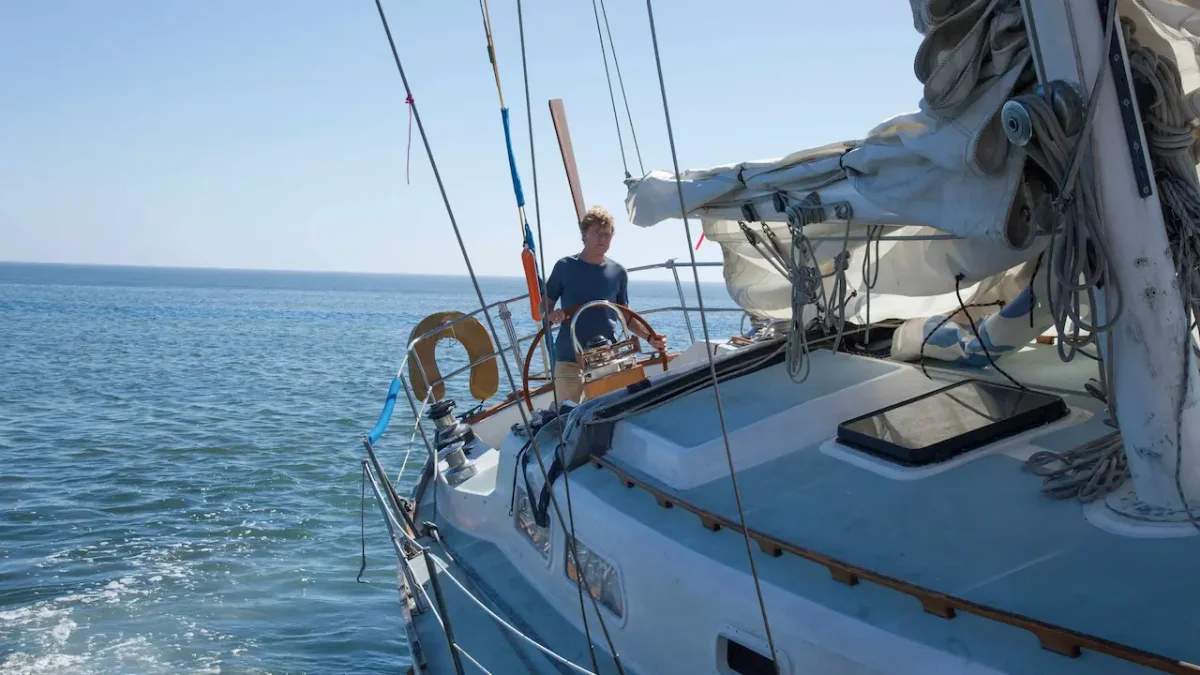
All Is Lost stands out as one of the most essential survival films in recent years, directed by J.C. Chandor. The film features Robert Redford in a solitary role, portraying an unnamed man lost in the Indian Ocean. As the narrative unfolds, he gradually loses everything: first his boat, then his means of communication, followed by food, water, and ultimately, the ability to control his own fate.
The film's conclusion pushes this narrative logic to its limits. Just when the man appears doomed, a light appears above him, accompanied by an outstretched hand. However, All Is Lost deliberately leaves it uncertain whether this salvation is real or merely the last vision of a dying man. This ambiguity is what gives the film its depth; the crucial question is not whether the man survives, but what remains of a human being when all control seems to vanish.
Chandor's Minimalism: A Reflection on Humanity and Nature
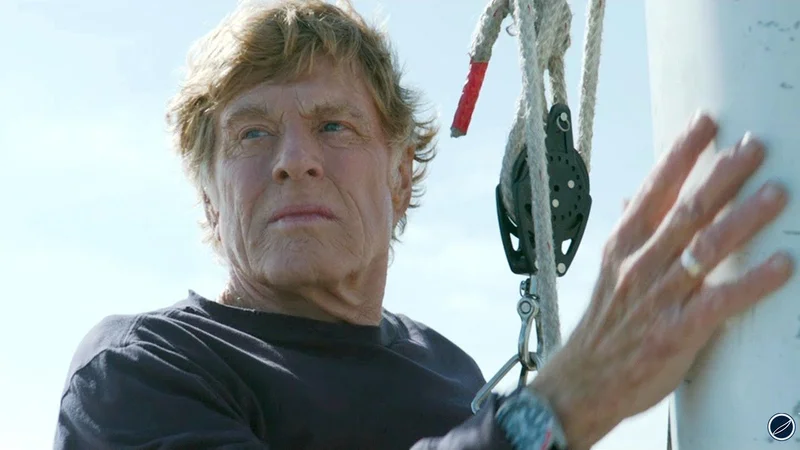
Released in 2013, All Is Lost may seem to fit within the survival genre, but Chandor strips away conventional storytelling elements. There are no companions, antagonists, explanatory dialogues, or flashbacks to reveal the protagonist's backstory. Robert Redford simply embodies “Our Man,” a character whose identity remains undefined, emphasizing that in this narrative, the past is less significant than his ability to confront the present.
This reliance on Redford's physicality is crucial. The actor, typically associated with characters marked by independence and self-reliance, gradually loses these traits. His experience proves inadequate when a drifting container punctures the hull of his boat. Repairs are only temporary, the radio ceases to be a viable means of rescue, and every attempt to reach the outside world fails.
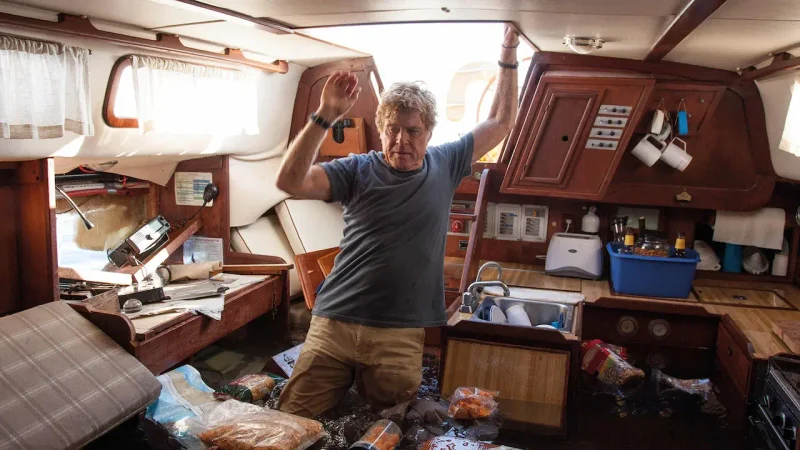
Chandor’s direction makes this process feel almost mathematical. Each solution brings about a new problem, and every small victory is quickly diminished. While the man repairs the breach, salvages some supplies, and attempts to navigate, these actions are rational yet ultimately lead him to a point where reason is insufficient.
In this way, the film shifts its focus. All Is Lost does not build tension around the question of how he will survive, but rather around a more unsettling inquiry: how long can the will to survive endure when the environment has stripped away almost every real possibility? The ocean thus becomes an impersonal force, devoid of intention and, as such, impossible to negotiate.
The Final Struggle: Losing the Illusion of Control
After abandoning his now unserviceable boat, Our Man reaches a life raft. This marks a significant transformation in the film: from captain of a relatively equipped vessel to an individual completely exposed to the ocean. Resources dwindle, thirst intensifies, and even his sense of direction becomes increasingly fragile.
When he spots a distant ship, he once again attempts to attract attention. Using available materials, he tries to ignite a fire on the raft, hoping to create a visible signal in the dark. However, the fire spirals out of control, forcing him to jump into the water.
The ship passes by without noticing him. This moment embodies the title All Is Lost in its most literal sense: every possibility seems exhausted. Exhausted, he slips beneath the surface and ceases to fight. Then, from his perspective, something changes the scene: a light, a boat, and a hand reaching out to him.
In that moment, Our Man finds a last reserve of energy and swims toward the surface. He stretches out his arm toward that hand as the image gradually fades to white. The film concludes before revealing what happens next.
This choice prevents a definitive conclusion regarding the man's fate. The boat could be real, and the hand could belong to rescuers. Alternatively, it might represent the dying man's perception, with the final white light symbolizing a passage from life to death. Chandor intentionally leaves both possibilities open, making the audience's interpretation a vital component of the ending.
The Intricate Dynamics of Control and Acceptance
The deeper significance of the ending arises from the preceding journey. For most of the film, Our Man responds to events methodically. He repairs, calculates, observes, retrieves, and plans. Each action stems from the belief that a problem can be addressed with a concrete solution. This mindset is profoundly human and, to some extent, Western: in the face of a crisis, the immediate response is to seek action.
However, the ocean gradually erodes this certainty. Not due to the protagonist's incompetence, but because there are circumstances that surpass individual control. Nature does not necessarily reward intelligence and does not respond to perseverance through a moral logic. A person can do everything right and still fail.
This makes the protagonist's namelessness particularly significant. Chandor nearly completely removes personal identity, transforming him into a universal figure. He could be anyone: an individual accustomed to managing his existence, suddenly forced to confront something beyond his control.
The silence of Robert Redford also contributes to this interpretation. The absence of dialogue prevents the audience from entering the protagonist's mind through direct explanations. What remains are his expressions, breath, gestures, and fears. In the finale, when that hand appears, all that matters is his reaction: Our Man chooses once again to try.
A Choice Between Hope and Acceptance of Death
The most intriguing aspect is that the two interpretations of the ending are not mutually exclusive thematically. If Our Man is saved, the conclusion represents survival as an event that transcends individual will. After doing everything he could, the man finally receives external help. Thus, salvation becomes something that cannot be entirely conquered through control.
Conversely, if that hand is merely an illusion and the protagonist dies, the ending takes on a more tragic character. His final gesture remains an act of will: even as his body succumbs, he reaches for the surface and extends his hand toward something. Death would arrive after a final resistance, not as mere surrender.
Ultimately, this is where the film transcends the simple question of “Is Our Man alive or dead?” All Is Lost constructs a struggle between control and helplessness throughout, choosing not to declare a winner in the final shot. The hand could represent tangible salvation or the mental image of what the man desperately wishes to find.
The concluding white light amplifies this ambiguity. It can be interpreted as a fade toward death or an opening toward a new possibility. In either case, what matters is the movement toward that light.
Thus, the ending of All Is Lost does not provide a definitive answer regarding Robert Redford's fate. Instead, it offers a perspective that aligns with the film's journey: the understanding that surviving does not necessarily mean triumphing over nature. It signifies continuing to seek a possibility even when all certainties have vanished. Perhaps this is why, after a film built on the notion that everything can be lost, Chandor opts to conclude with a hand reaching out toward another: because until the last moment, the chance of salvation remains open.