Understanding the Ending of The Shape of Water: What Does the Final Scene Mean?
Guillermo del Toro's The Shape of Water is a romantic fairy tale set in Cold War America, exploring themes of love, communication, and otherness through the relationship of a mute woman and a creature. The film's ending raises questions about reality and legend.
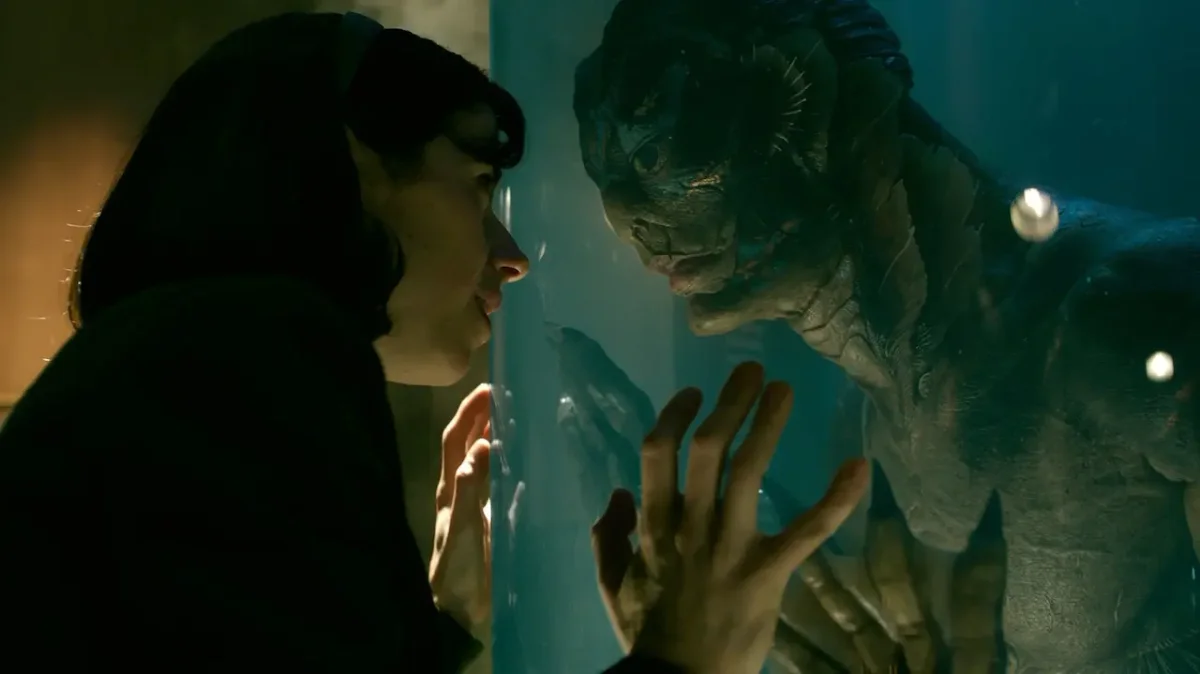
The Shape of Water by Guillermo del Toro is a romantic fairy tale set against the backdrop of Cold War America, where a mute woman discovers a unique form of communication and love with a creature that others deem a monster. The film starts with the codes of a monster movie, intertwines them with fairy tale elements, and culminates in an ending that appears to offer a classic happy conclusion, while leaving a crucial question open: Does Elisa truly survive, or is her story transformed into a love legend by those who recount it? This ambiguity adds layers to the conclusion, making it far more intriguing than a mere romantic reward.
To grasp the ending of The Shape of Water, one must look beyond the final confrontation between Elisa, the creature, and Colonel Strickland. The transformation of the scars on Elisa's neck into gills, the underwater escape, and Giles’s narration create a conclusion that hovers between reality and fairy tale. The film suggests that Elisa has finally found her place in the world, yet it retains the same uncertainty that del Toro previously employed in Pan's Labyrinth: what we see may either be real or a means through which a love story survives loss.
How Guillermo del Toro Transforms the Monster Movie and Romantic Fairy Tale into a Love Story about Otherness
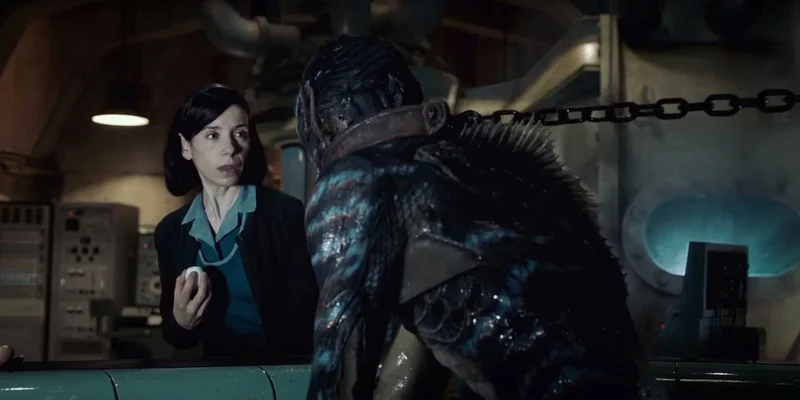
The Shape of Water emerges from Guillermo del Toro's passion for fantastical cinema and monstrous creatures. The most evident reference is Creature from the Black Lagoon, a classic from 1954 in which an amphibious being falls in love with a human woman but inevitably becomes a threat in the eyes of mankind. The director completely flips this structure: the creature is no longer the monster to be eradicated but rather the romantic protagonist, while the true monstrosity lies with the humans who seek to control it.
This inversion is directly tied to the filmmaker's ethos, already evident in Hellboy, Pan's Labyrinth, and Crimson Peak. In his films, the fantastic often serves as a tool to question normality, with creatures deemed different frequently displaying greater humanity than the humans surrounding them. Elisa embodies this tradition: she is mute, lives on the fringes of society, and communicates through sign language.
The fairy tale structure is also essential. Elisa is akin to a voiceless princess, while the creature represents the prince transformed into a monster. However, The Shape of Water modifies a central element of tradition: neither character needs to conform to societal expectations to live their love. The conclusion thus realizes a fantasy of liberation from the notion that there is only one possible form of normality.
What Happens at the End of The Shape of Water and Why Elisa Can Finally Live Underwater
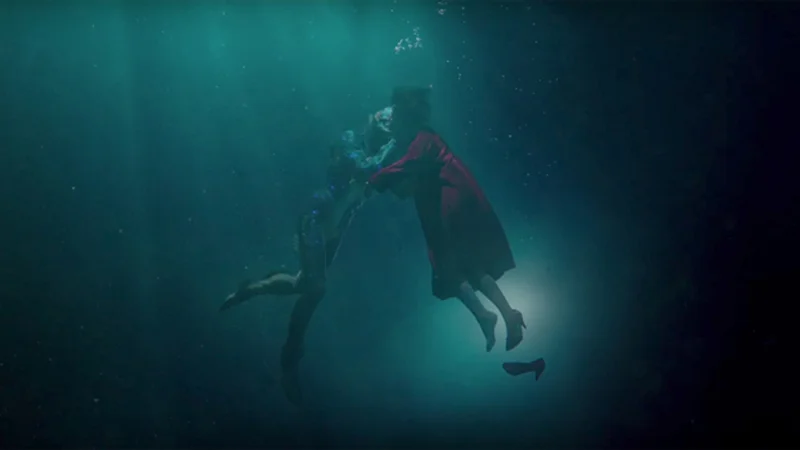
In the climax, Strickland confronts Elisa and the creature at the canal where she was supposed to free the amphibious being. The colonel shoots both, inflicting severe wounds. However, the creature survives due to its regenerative abilities and retaliates against Strickland, fatally injuring him. Before dying, the man finally understands what he had refused to accept: the creature he regarded merely as a subject of study is something far greater than himself.
At this point, Elisa appears to be dead. The creature takes her body and submerges into the water, marking a pivotal transformation: the scars on Elisa's neck open up, morphing into genuine gills. This act can be interpreted as a miraculous healing or as the revelation of a nature Elisa has always possessed but was never allowed to explore.
Giles's narration then tells us that the two remained together and lived their love. The final scene, set in the future, shows Elisa beside the creature, now part of an aquatic world that can be interpreted as their ultimate refuge. The film seems to lean towards a happy ending, yet del Toro avoids making it entirely rational: the transformation belongs to the logic of fairy tales, where love can even alter the rules of reality.
Elisa, the Creature, and Strickland Represent Three Opposing Views on the Unknown
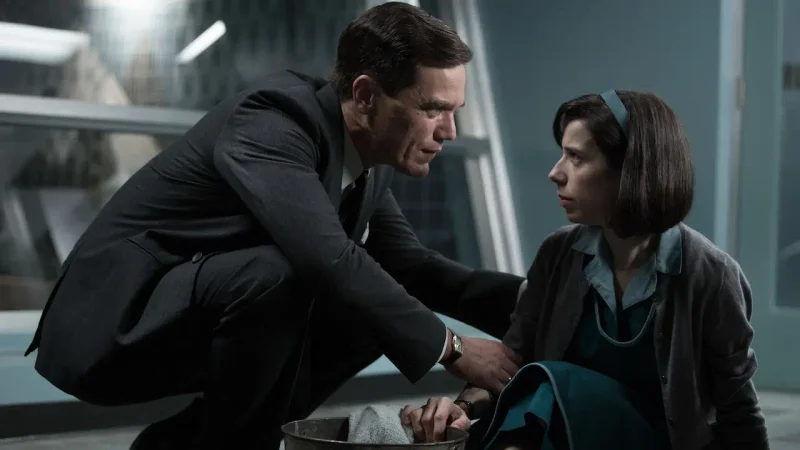
The true conflict in The Shape of Water revolves around otherness. Both Elisa and the creature are beings unable to fully adapt to the system they inhabit, yet this very condition allows them to recognize one another. She does not need words to understand him; he does not need words to understand her. Their relationship thus stems from a communication that predates verbal language, established through body language, gaze, water, and desire.
Strickland, on the other hand, embodies the attempt to classify and dominate what eludes conventional categories. He is a man convinced that his social position, power, and idea of normality enable him to define what is human and what is monstrous. His obsession with the creature gradually reveals a violence that does not stem from the fantastical element but from the need to exert control.
In this sense, the ending decisively flips the perspective. The presumed monster becomes the one who saves Elisa, while the man who considers himself superior dies precisely because he cannot recognize the humanity of the other. Water thus takes on a specific symbolic value: it is the space where earthly hierarchies lose their significance, allowing Elisa to exist without needing to be defined by what she lacks.
The Ending Echoes Pan's Labyrinth and Reiterates the Question of the Boundary Between Reality and Fairy Tale
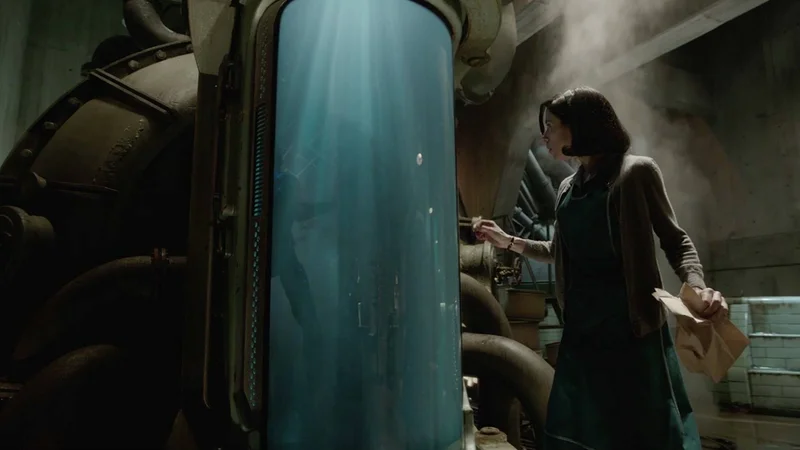
The conclusion of The Shape of Water gains further significance when viewed in relation to Pan's Labyrinth. In that film, del Toro also portrayed a protagonist living in a world dominated by violence, finding in the fantastic a potential escape route. However, in the 2006 film, the boundary between reality and imagination remains painfully ambiguous: what happens to Ofelia can be interpreted as either a genuinely existing fantastical dimension or as a construct through which the girl confronts an unbearable reality.
The Shape of Water employs a similar strategy but directs it towards romanticism. We know that the creature truly exists, so the film does not question its presence. The ambiguity rather concerns Elisa and her transformation. Initially, we see her already submerged in water, as if her story has been narrated by someone who only knows the final outcome. Giles's narration also lacks the authority of an omniscient narrator.
This element leaves open a fascinating possibility: Elisa may have genuinely survived and reached the creature in its natural habitat, or Giles may have turned her disappearance into a love story destined to continue beyond death. However, the film clearly leans towards the former interpretation. Where Pan's Labyrinth uses the fantastical to heighten the pain of a tragedy, The Shape of Water employs ambiguity to safeguard its happy ending.
What Does the Ending of The Shape of Water Truly Mean: Love Allows Elisa to Stop Being “Different”
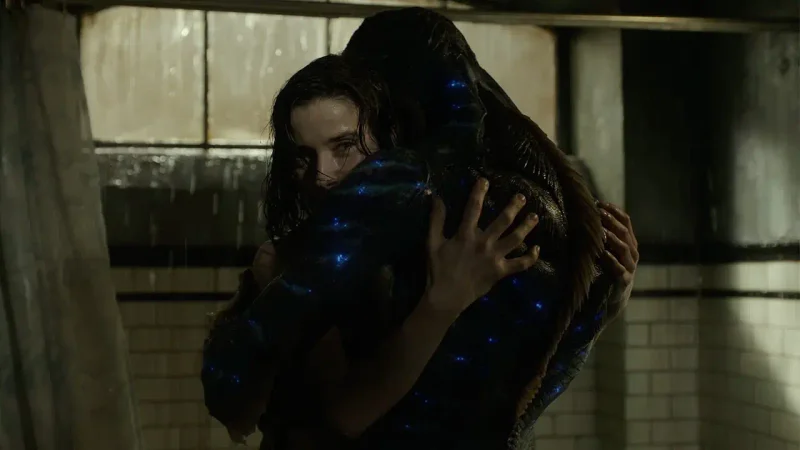
The deeper meaning of the ending lies in Elisa's transformation. For much of the film, the protagonist is defined by society through a lack: she does not speak, she is a woman, she belongs to a marginalized social class, and she lives in an era where many people around her view otherness as something to correct or repress. The creature, conversely, is literally imprisoned for not fitting into human categories.
When Elisa enters the water, these definitions finally lose their power. She no longer needs to become like others, nor does she need to ask the creature to become human. It is the outside world that proves incapable of understanding a relationship that does not adhere to its conventions. The gills thus represent a liberation: what seemed like a wound becomes an essential organ for her new existence.
The conclusion can also be interpreted as a response to the fairy tale's central question: who must change to be able to love? In traditional versions of Beauty and the Beast, it is often the male creature that is transformed and returned to human form. Del Toro subverts this convention. Elisa retains her diversity and, in fact, acquires a non-human characteristic that allows her to finally reach the one she loves.
Thus, the ending of The Shape of Water transcends a mere happy conclusion. It is the logical conclusion of a film that has spent its entire duration questioning the distinction between human and monstrous. Strickland dies because he views the different as something to possess or destroy; Elisa survives because she embraces the different to the point of recognizing herself in it.
Finally, Giles's voice retains that slight uncertainty that prevents the fairy tale from becoming a simple explanation. If Elisa truly lives, she has found a place where her diversity is no longer a curse. If her story has instead become a legend recounted by Giles, love has still triumphed: it has transformed a potential death into a story of liberation.
It is here that Guillermo del Toro completes the dialogue with Pan's Labyrinth. In that film, the fantastic can be interpreted as a refuge for a child facing death; here, it becomes the concrete possibility of imagining a life beyond the boundaries imposed by reality. The Shape of Water thus chooses to believe in the fairy tale: the monster can be loved, the voiceless woman can find her voice through her body, and water can become the space where what the world deems impossible finally takes form.