
Christopher Nolan's 'The Odyssey': A Woke Trojan Horse?
Christopher Nolan's adaptation of 'The Odyssey' has sparked discussions about its fidelity to Homer and the influence of WOKE ideology. A deep dive into the film's characters and themes reveals its complexities.
Christopher Nolan's 'The Odyssey': A Woke Trojan Horse?
The Odyssey by Nolan has pleasantly surprised me. I likely wouldn't have seen it if my friend Chema hadn’t dragged me to Moraleja Green to watch it. For that, I am grateful, as the film exceeded my expectations.
Initially, my hesitations stemmed from the WOKE contamination that surrounded the film since the release of its second trailer. Before diving into the film itself, I want to share some thoughts on aspects that didn't resonate with me, followed by a deeper analysis of the film, which I will give a spoiler alert for in advance.
Reaction to the Trailers of 'The Odyssey'
The first trailer was impressive and promising, suggesting that Nolan had immersed himself in Homer’s work. I even referenced it in one of my Communication and Society classes, believing we were about to witness a cinematic masterpiece. And indeed, it is a masterpiece, but it comes with its flaws that must be acknowledged.
One of the most controversial aspects is the casting. I will also discuss the film’s fidelity to Homer, particularly regarding character psychology, especially that of Odysseus. While I will touch on the film's format, I will refer to someone who has articulated this better than I could. Finally, I will delve into technical elements such as the setting, costumes, sound, music, and lighting.
However, the true source of contention lies in the Orwellian version of Emily Wilson’s 2017 translation. Why do I describe it as "Orwellian"? Because her English translation intentionally omits the original work's exaltation of masculinity, effectively deconstructing male characters akin to the series Alpha Males (which, despite its title, ironically embodies the antithesis of such deconstruction). The result is that the noblest character in the film is portrayed by a woman who has transitioned, thereby erasing the essence of the male characters' goodness, with perhaps the exception of Telemachus, who remains young and innocent.
The casting choice led many of us who celebrated the first trailer to disdain the second, as we realized that yet again, a film was being made with political motives, forcing inclusion into a narrative that originally did not call for it, all in an effort to rewrite history. We are left with few exceptions and many disappointments to endure until this WOKE trend subsides, if it ever does, as it appears to be just the tip of the iceberg of the 2030 Agenda looming ahead, signaling the decline of the West.
The Odyssey of Emily Wilson… and Nolan vs. J.R.R. Tolkien
Returning to the translation, it distorts and perverts the original work, transforming it into a manipulation and an indecent, immoral rewriting of the text. This is not merely about new content; it imposes its vision over that of the original author. This echoes Tolkien’s assertion, rooted in his Catholic beliefs, that "evil cannot create or invent something genuinely new; it can only corrupt, imitate, or destroy what good has produced." This reflection could encapsulate this script and 85% of today’s scripts.
Woke, Woke, Woke, and Woke…
Linking Tolkien to WOKE ideology illustrates a dichotomy between good and evil. Tolkien crafted an entire cosmogony for his literary works, whereas the WOKE movement has created nothing. If we accept that Homer existed as a singular author and did not draw from numerous prior sources (a debate often directed at Shakespeare), then the WOKE movement has achieved nothing and will continue to achieve nothing, as it is inherently sterile, born from a nature destined to destroy rather than create.
WOKE ideology merely perverts the works of established authors, contradicting their original messages and rewriting them, not out of creative intent, but as a form of revenge. Thus, without intending to, WOKE ideology validates Tolkien’s assertion.
Presentism
For instance, in Nolan's narrative, the cause of the Trojan War is depicted as Agamemnon’s ploy to control Black Sea trade routes. This drastically alters the philosophy and literature of Homeric texts, reflecting a presentist interpretation aimed at criticizing U.S. wars in the Middle East, with the classic narrative of "they care about oil." Some view this interpretation as anti-war, while I perceive it as anti-capitalist and anti-Western.
Of course, oil matters, and we cannot allow a few tyrants to manipulate our resources. However, while defending our interests, we must acknowledge that the conflict's true cause, as articulated in the original text, was the abduction or elopement of Helen with Paris.
With that said, let’s turn to the film itself, and I will now issue a spoiler alert.
'The Odyssey'
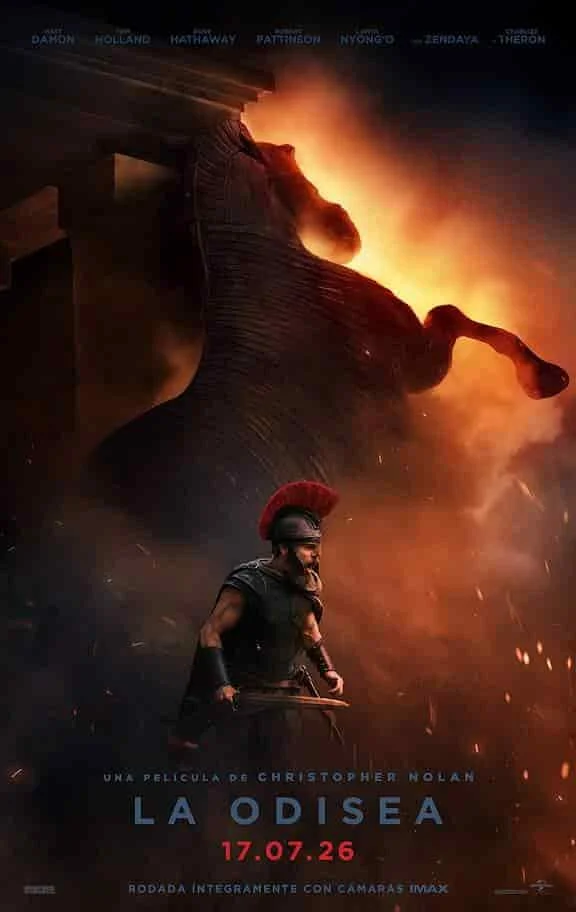
To discuss it, I will compare the episodes shown in the film with those in the book, noting which appear in both, which remain faithful, which change, which vanish, and which are omitted but merged into others for pacing.
I will also focus on specific characters to see how they align with their literary counterparts. Additionally, I will address the role of the gods and the essence of the Odyssey itself.
From the outset, this adaptation diverges from the original text, incorporating elements from The Iliad. Whenever The Iliad is referenced, it detracts from The Odyssey, as the film's most significant doses of WOKE ideology arise from flashbacks of Odysseus, who, piece by piece, is depicted as an anti-war advocate. While I don’t mind this approach (it would be more acceptable if it had been Homer's intent), it does so by deconstructing Odysseus himself, who seemingly loses his memory and, as he recalls the war, grows increasingly ashamed and regretful.
“The Pirate Code”
Have you seen Pirates of the Caribbean? I enjoyed the first installment despite its pirate code.
That code serves as a trap for the viewer, condescendingly treating us as simpletons and allowing the screenwriter to regain focus whenever the plot strays. It’s akin to the "center" button in Google Maps. Films where characters adhere to a code they must recite for the audience’s benefit are inherently deceptive.
When characters in Pirates of the Caribbean invoke the pirate code, it irritates me. It’s a blatant call to the viewer to pay attention, as if we were idiots. This contradiction undermines the anarchic nature of pirates, whose only law is that there is no law.
Similarly, in this film, while the Greeks of that era (not the inclusive mishmash depicted here) respected their gods and were cautious not to defy their wills, it’s absurd for characters to invoke "the law of Zeus" repeatedly, as if they are treating the audience as simple-minded. Let’s stop being patronized.
Let’s Begin with the Characters in This Odyssey…
I’ll only discuss the main characters to avoid prolonging the commentary.
Odysseus – Matt Damon
He is our protagonist. Odysseus is the name from which the title of the work derives. This narrative continues The Iliad, representing the Greek hero's journey home. He is a hero primarily because he devised the ruse of the wooden horse, which ended a ten-year war and conquered an impregnable city.
Only Matt Damon could embody this Odysseus, thanks to his stature, expression, and demeanor.
However, in this revisionist, overly kind, and presentist version, Odysseus is portrayed as feeling immense shame over the disastrous aftermath of opening the gates of Troy. While I acknowledge that wars lead to atrocities—just ask the millions of German women who were violated by the Red Army as it advanced toward Berlin—
From The Odyssey to The Iliad and Here We Go…
The essence of The Odyssey was never to denounce pillaging, rapes, or indiscriminate deaths caused by Greek soldiers. In fact, those themes don’t appear, nor should they, as they belong to The Iliad. Altering this message to depict Odysseus as tormented by the indirect consequences of his decisions diminishes his heroic stature. This could have been an intended effect of rewriting his character.
Yes, Odysseus carries burdens—many of them—but every challenge he faces strengthens him, making him wiser, tougher, and more regal, not someone eager to flee.
The purpose of The Odyssey is to narrate the reunion of two lovers separated for twenty years. However, for that reunion to happen, the protagonist must first reconnect with himself. Thus, he wanders for a decade, sometimes propelled by his cunning, other times hindered by his arrogance, but always driven by love. He is held back by Poseidon.
Penelope – Anne Hathaway
I am fascinated by Anne Hathaway. Who isn’t?
I believe this role fits her perfectly. I have previously commented that if I regret anything about her performances, it’s the Spanish dubbing, which often makes her sound on the verge of tears, rendering her overly emotional. However, in this film, which also calls for such emotion, the voiceover actress has finally captured the character's tone correctly.
Moreover, Hathaway's beauty and strength shine through, portraying a Penelope that exudes vigor, resilience, and the weight of a mother and queen. She breaks down when expressing her longing for her beloved in their marital bed.
We must remember that Penelope is crucial to this narrative. With her husband and king missing, she shoulders the responsibility of ensuring that Telemachus has a throne and crown to inherit, should the need arise. She doesn’t know if her husband is alive or dead, just as he is uncertain about her and Telemachus’s fates.