
Film Review: Under the Sky of Kyoto
An exploration of Akiko Ohku's romantic drama 'Under the Sky of Kyoto,' highlighting its emotional depth and character authenticity.


Under the Sky of Kyoto

Japan, 2024 Original Title: Kyo no Sora ga Ichiban Suki to Mada Ienai Boku wa Director: Akiko Ohku Screenplay: Akiko Ohku, based on a story by Shusuke Fukutoku Cast: Riku Hagiwara, Yuumi Kawai, Aoi Ito, Kodai Kurosaki Distributor: Art House Films Genre: Romantic Drama Duration: 2h08 Release Date: July 22, 2026
Rating: 3.5/5
The romantic melodrama Under the Sky of Kyoto unfolds with a certain ambiguity, leaving viewers unsure of its ultimate direction. The film’s strength lies in its ability to engage audiences emotionally through its unexpected twists, which, under different circumstances, might have felt clichéd. Akiko Ohku’s film captivates with its heartfelt surprises, creating an emotional intensity that invites viewers to share in the characters' experiences.
Drawing on familiar tropes of the genre—such as the shy, solitary student, an unlikely romance, and the cruel twists of fate that threaten love—the narrative skillfully navigates between traditional elements of grand love stories and a modern reinterpretation filled with unforeseen details. Central themes of solitude and the fragility of emotions contribute to this refreshingly unique tale.
As the story progresses, audiences find themselves identifying with the characters' romantic struggles, which resonate universally despite their distinctly Japanese context. The sincerity of Riku Hagiwara and Yuumi Kawai’s performances imbues their budding relationship with an endearing uniqueness. The subjective narration shifts in accordance with the protagonist’s emotional state, striking a balance between the audience’s feelings and a compassionate view of a young adult grappling with his own fantasies, often blind to the emotional realities surrounding him.
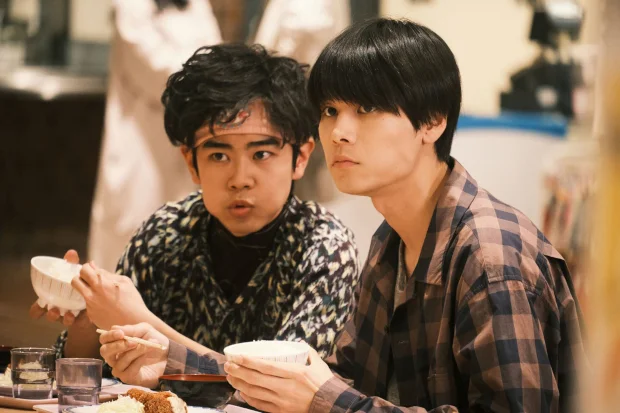
Synopsis: After several months away, Tôru Konishi returns to Kyoto University for his second year. From his first lecture, he is captivated by Hana Sakurada, a new classmate who shares his solitude. However, hidden beneath his umbrella, which serves as a shield from the world, he struggles to express his feelings. To make some extra money, he resumes his late-night job cleaning public baths alongside the young musician Sacchan.
Turning Up the Volume
At first glance, the central message of Under the Sky of Kyoto could be seen as a typical encouragement for personal growth through love. After all, what better way to overcome personal inhibitions than by falling in love? This gradual opening up to another person can lead to a shared life. Fortunately, Akiko Ohku’s dramatic approach is far more nuanced. While she incorporates common elements of love at first sight and the concept of serendipity, she allows her characters the space to maintain romantic suspense, yielding impressive results.
The narrative beautifully captures the uncertainty with which Konishi approaches this unexpected opportunity. Initially, there is ambiguity surrounding the protagonist’s psychological profile, as he could easily resemble the growing number of characters on screen who are on the autism spectrum, living a routine life largely disconnected from social inclusion. Additionally, the complexity of his emotional challenge becomes apparent, as his hermit-like existence has ill-prepared him for such possibilities—his previous girlfriend's story remains unexplored with his close friend Yamane, leaving him floundering in his attempts at romance.

The Triumph of Supporting Roles
The first major twist in the narrative introduces responsibilities that Konishi had not previously considered, just as the audience is ready to embrace the budding relationship between him and Hana. This twist disrupts the romantic harmony that has been developing, introducing a significant change in tone that is both radical and refreshing. It takes its time to highlight the tension in the protagonist's life, allowing Aoi Ito, in a seemingly minor role, to voice the struggles of those who cannot confess their feelings to the one they love from afar.
This unexpected turn opens the door to a love triangle with imbalanced dynamics, leading the story in unexpected directions as it unfolds with a gentle firmness. However, it would be misleading to lament the derailment of a narrative that had previously seemed so predictably sweet.
As in the earlier sections of Under the Sky of Kyoto, Akiko Ohku’s direction focuses on the emotional authenticity of her characters. This authenticity remains paramount, whether depicting Konishi's slow descent into despair—before a heart-wrenching rebirth—or capturing the poignant humanity of a minor character, the public bath owner, portrayed with touching depth by Arata Furuta.

Conclusion
In cinema, love has been explored from nearly every angle. The romantic attraction—fulfilled or thwarted—has inspired filmmakers for over a century. Under the Sky of Kyoto does not claim to innovate in this realm. However, what Akiko Ohku's beautiful film accomplishes is to resonate deeply with viewers for two hours, immersing them in the emotional ups and downs experienced by its innocent characters. In an era where cynicism and a retreat into oneself wreak havoc, particularly among the younger generation, this emotional connection is a significant achievement.
You may also like



![Ici tout commence: What to Expect in Episode 1488 on Monday, July 27, 2026 [SPOILERS]](https://glowculturehub.com/cdn/images/b2d3d6d788c39a22a548df320e6d9f77/w1200.webp)